Showing posts with label Sorrow. Show all posts

Monday, January 29, 2024

TBR: Mom in Space by Lisa Ampleman

TBR [to be read] is a semi-regular, invitation-only interview series with authors of newly released/forthcoming, interesting books who will tell us about their new work as well as offer tips on writing, stories about the publishing biz, and from time to time, a recipe. 


Give us your elevator pitch: what’s your book about in 2-3 sentences?


In poems and a few lyric essays, Mom in Space addresses infertility, parenting, and chronic illness through the perspective of a woman interested in the history and biology of spaceflight. With an eye on both the intergalactic and the terrestrial, these poems take place on an Earth affected by climate change, nuclear waste, and racism: “We don’t have enough rare-earth / metals to build a fleet of starships. // We just have the rare Earth” (“Calamity Days”).


Which essay or poem did you most enjoy writing? Why? And, which essay or poem gave you the most trouble, and why?


I enjoyed writing a lot of the book—when I tell people about the writing that happened in 2020 and 2021 in particular, I often just say in amazement, “It was so fun!” Of course, some of the poems tapped into emotionally challenging experiences (see below), but “Alpha,” for example, felt like wordplay and spending time with concepts that fascinate me, like the Van Allen belts of radiation and the radio waves that come from pulsar stars.


“Lava Tubes on the Moon” gave me the most trouble, in a way. I’d been wanting to write a poem with that title for quite a while, but that’s not usually how my creative process works, so I had a lot of false starts. Then I started writing a poem about my experience of miscarriage with my husband, thinking about what he might have felt, since so much of the book is me processing that and other things. I struggled to have those two concepts live in the same space together for a while, I struggled to revisit that moment in the hospital, and I struggled to figure out the poem’s form until I thought about really long lines (that would still fit on a 6 x 9 page of poetry) alternating with emptiness, gaps—tubes, if you will. Until the speaker brought out sweatpants and spinach dip, the poem felt very inert as well. I’m happy with how it turned out in the end, though I don’t know if it’ll be one I choose for readings because of how it brings me back there to that hospital bed.


Tell us a bit about the highs and lows of your book’s road to publication.


Because I published my second book at LSU Press and they had first right of refusal for my next project, I knew there was a strong chance to work with them again—but that I had to do the work as if I was pitching to them for the first time. I loved working with them and was interested in doing so again. Once I felt like the book was ready, I sent it to James Long, curator of the poetry series. They sent it to a peer reviewer (university press!), who recommended to publish it with a few small suggestions for revision.


So, in my case, publication wasn’t as difficult as getting to the book itself—that’s more like the low point. After my son was born in 2015, I didn’t do much new writing. I kept submitting what became Romances, but individual poem drafts often failed. Then in 2019, I got notified by the Hermitage Artist Retreat that I’d been awarded a residency there—the kick is that I had never applied; they choose their residents differently. I was floored and flummoxed. I wasn’t sure at first I could take time away from my family. But I did, in February 2020, and I brought along a book about the Apollo program I’d been wanting to read since we’d visited an Apollo 11 capsule exhibit at the Cincinnati Museum Center. I got hooked and started writing space poems and reading more about spaceflight. Two weeks after I got home from Florida, the pandemic lockdown began, and the combination of time, fear (about the pandemic as well as a spinal arthritis I’d just developed), and space obsession put the book into motion at last. As I say in “Neil and Me and Work and the Body,” an essay in the book, “A pandemic raged, my body hurt, but I could escape to space.”


What’s your favorite piece of writing advice?


That a fallow period—which somehow is even listed in the Merriam-Webster Dictionary!—is okay. I’m loosely in such a place now, dabbling with a few things but between focused work. As I mentioned above, I was in a fallow period for years before things kicked into gear in 2020. Just till the soil and fill the well with reading, beauty, contentment, and perhaps other kinds of creative work until it’s time to enter an active time again.


My favorite writing advice is “write until something surprises you.” What surprised you in the writing of this book?


At times while I worked on this book, I found myself writing down things I wouldn’t say out loud or bring up in conversation. I loved the rhythm of “My mother never taught me / to hover over the / public bathroom toilet” (the opening of “Public Intimacies”), but I was surprised that I’d put it into words, then in a poem, then submitted that poem to magazines, then included the poem in a book I knew might get published. I’m vulnerable in this book in ways that surprise me still. I wonder if part of that vulnerability stems from how much of the writing happened in the first year of the pandemic, when I had more time to be alone and introspective and feel like I wasn’t in the public sphere.


How did you find the title of your book?


During the early days of the pandemic, my husband, son, and I spent a lot of time relaxing on couches together. I don’t remember exactly when, but at some point in that era, my son (then four or five), was talking as he is wont to do while he plays games on his tablet. He knows I like space—I was probably reading a book about SkyLab or the shuttle program—and among the other slightly singsong-y things he said was “a mom in space.” I typed it into the notes app on my phone right away. So, I knew fairly early in the process what the title could be, and it probably shaped some of the work that happened after that.


Inquiring foodies and hungry book clubs want to know: Any food/s associated with your book? (Any recipes I might share?)


Well, since I mentioned spinach dip above, here’s a pretty simple version.


*****

READ MORE ABOUT THIS AUTHOR: https://lisaampleman.com/


ORDER THIS BOOK FOR YOUR TBR STACK~~

PUBLISHER SITE: https://lsupress.org/9780807181256/mom-in-space/

SIGNED COPIES: Downbound Books


READ 2 POEMS FROM THIS BOOK: https://therumpus.net/2021/12/21/rumpus-original-poetry-two-poems-by-lisa-ampleman/


Monday, November 13, 2023

TBR: All Things Edible, Random and Odd: Essays on Grief, Love and Food by Sheila Squillante

 TBR [to be read] is a semi-regular, invitation-only interview series with authors of newly released/forthcoming, interesting books who will tell us about their new work as well as offer tips on writing, stories about the publishing biz, and from time to time, a recipe. 


Give us your elevator pitch: what’s your book about in 2-3 sentences?


All Things Edible expresses the complexities of unresolved relationships, the importance of shared experiences, and how family and food make us who we are.


Which essay did you most enjoy writing? Why? And, which essay gave you the most trouble, and why?


I had such fun writing “The Greenland Shark” because I borrowed the format from a Wikipedia entry and included much more research than is typical of my largely memoiristic essays.


“On Crying” was toughest to write because I was still raw from my mother’s death from cancer earlier that year. While there are many essays in the book about my father’s death, they were all written years later, when I had emotional and narrative distance. I cried through the writing of “On Crying,” and I cried the only time I’ve read it out loud.


Tell us a bit about the highs and lows of your book’s road to publication.


This book has taken 20 years to find a publisher. This is not an exaggeration. The earliest of these essays was written in 2003. When I began, I expected it would be what I was calling a “mosaic” memoir focused only on my relationship with my father, who died when I was in college, through the lens of food and the meals we shared (when it was hard to share much else). But the memoir market is fickle, and agents and publishers kept telling me it was too fragmented/episodic. Too much like a linked short story collection when it needed to be more like a novel in terms of development and arc. Well, that’s not and clearly never was going to be what this book is. While it was painful to keep getting told the writing was beautiful but the project unsellable over and over, in the end I’m glad it took the time it did to find a home because it allowed me to capture a much richer, more expansive portrait of my life. And most of it still through the lens of food. It’s a far better book for having been made to wait.


What’s your favorite piece of writing advice?


“Don’t write what you know; write what you’re willing to discover.”—the poet Yusef Komunyakaa


My favorite writing advice is “write until something surprises you.” What surprised you in the writing of this book?


Humor surprised me. I don’t think of myself as particularly funny? And certainly the subject matter throughout is pretty heavy. So, it was a nice surprise to find, and be told others found, moments of lightness or laughter.


How did you find the title of your book?


My publisher, Christoph Paul of CLASH Books, finally found the title, which is shared with the lead essay in the book, and which we both love. But, funny thing: it’s also the name of the blog I started when I first began writing about food and my father back in the early 2000’s. So, pre-destined!


Inquiring foodies and hungry book clubs want to know: Any food/s associated with your book?


Oh yes! Come in hungry because we’ve got manicotti, meat ragu, fermented shark, lamb shanks, chana daal, Christmas cookies coated with Elmer’s Glue and at least three kinds of turtle soup. [See excerpt link below for a recipe within an essay!]


*****


READ MORE ABOUT THIS PUBLISHER: www.clashbooks.com


ORDER THIS BOOK FOR YOUR OWN TBR STACK:  https://www.clashbooks.com/new-products-2/sheila-squillante-all-things-edible-random-odd-preorder


READ AN ESSAY [IN THE FORM OF A RECIPE] FROM THIS BOOK, “Meat Ragu a la Squillante”: https://sweetlit.com/5.1/proseSquillante.php


Monday, June 12, 2023

TBR: Swimming with Ghosts by Michelle Brafman

TBR [to be read] is a semi-regular, invitation-only interview series with authors of newly released/forthcoming, interesting books who will tell us about their new work as well as offer tips on writing, stories about the publishing biz, and from time to time, a recipe. 


Give us your elevator pitch: what’s your book about in 2-3 sentences?


SWIMMING WITH GHOSTS is set in June 2012. The magical and slightly cultish River Run swim club is alive with the spirit of fun competition when a perfect storm brews between team moms and best friends, Gillian Cloud and Kristy Weinstein. The ghost of family addiction has turned up, forcing them to face their unresolved childhood trauma. Real sparks fly on the night of the derecho—a freak land hurricane—which sweeps through Northern Virginia, knocking out power for days, igniting a tinder box of family secrets that threaten to destroy the lives Gillian and Kristy have worked so hard to create.


Which character did you most enjoy creating? Why? And, which character gave you the most trouble, and why?


The same character I enjoyed creating was the one who gave me the most trouble! I loved writing Gillian Cloud, the uber swim mom who cannot relinquish control over every aspect of the River Run Manta Rays swim team, even after her youngest child is too old to compete. Her antics are ripe for satire. That said, her obsession with the pool is rooted in her family history. River Run is a sacred space for Gillian because it was the only place where her charismatic, alcoholic father did not drink to excess. So she is really clinging to this oasis.

Gillian was tricky because my beta readers kind of hated her controlling, Ms. Fix-it behavior. The more I dug into the source of her vulnerability, though, the more human she became to my early readers. That’s what I love about writing. Those moments of grace.


Tell us a bit about the highs and lows of your book’s road to publication.


The book went out on submission in March of 2020, when we were all trying to figure out life in a global pandemic. The novel got no traction. That low lasted for a couple of  years. In February of 2022, a publicist from Turner Publishing asked me to blurb one of their novels, and throughout the course of our correspondence, I discovered that Turner had hired a fabulous new acquisitions editor. He totally understood what I was up to with this novel and bought the book quickly. That was a high!


What’s your favorite piece of writing advice?


Ask someone to read your work aloud to you. My husband read me late drafts of my first two books, and over my son’s winter break from college, he parked himself in my office and read me Swimming with Ghosts. They both uncovered plot, character, and continuity issues I couldn’t see as well as smaller things like word repetition and pet gestures and verbs that should probably only be used once in an entire novel! When I’m listening to someone read the book, I can also hear when my rhythm is off and which hinky sentences need fixing. I do love the intimacy of the exercise, and I often read for my writer friends.     


My favorite writing advice is “write until something surprises you.” What surprised you in the writing of this book?


The story’s hopefulness. At first, I was focused on rendering a world where parents were working out their stuff in their kids’ arenas, but as I got to know the nature of my characters’ troubles, I realized that they, we, I, have the capacity to transcend our most troubling family legacies. And I’m sure rooting for all of us to do so!


Who is your ideal reader?


I’m always surprised by who reads my books, which is part of the fun of putting a story out into the world. I suppose my ideal reader is someone who enjoys a little suburban satire, someone whose life has been impacted by any form of addiction, and maybe a parent who has experienced one of those “I think I went too far” moments that can materialize in any kid-related arena, be it the River Run pool, a hockey rink, or ballet studio.


Inquiring foodies and hungry book clubs want to know: Any food/s associated with your book? (Any recipes I might share?)


Whoopie pies! This treat actually serves as a plot point in the book. When tension and competition rears its ugly head between Gillian and her best friend Kristy, Kristy swipes the dessert and the affection of one of the younger swim moms.


Link to recipe: https://www.allrecipes.com/recipe/10016/whoopie-pies-i/


*****

READ MORE ABOUT THIS AUTHOR: www.michellebrafman.com


ORDER THIS BOOK FOR YOUR TBR STACK: https://www.amazon.com/Swimming-Ghosts-Novel-Michelle-Brafman/dp/1684429544/ref=sr_1_1?qid=1683118757&refinements=p_27%3AMichelle+Brafman&s=books&sr=1-1


READ AN EXCERPT OF THIS NOVEL: https://turnerbookstore.com/products/swimming-with-ghosts (below image of cover)


Monday, September 26, 2022

TBR: The Witch Bottle and Other Stories by Suzanne Feldman

TBR [to be read] is a semi-regular, invitation-only interview series with authors of newly released/forthcoming, interesting books who will tell us about their new work as well as offer tips on writing, stories about the publishing biz, and from time to time, a recipe.


Give us your elevator pitch: what’s your book about in 2-3 sentences?


From Depression era Mississippi to the suburbs of modern America, to the trials and tribulations of smart young women struggling to make a name for themselves in the arts, Feldman delves deep into the dreams and emotions of regular people and makes them beautiful and accessible. This prize-winning collection of short stories and two novellas, offers entrancing tales of redemption, betrayal, tradition, and rebellion. These narratives range in mood from "The Lapedo Child," a tale of discovery and liberation, to "The Witch Bottle,” a comic examination of a pair of obsessed next-door neighbors. “Untitled Number 20” explores life among women artists at the end of the Flower Power era and the beginning of the Seventies. “The Stages” is a meditation on one woman’s struggle for dignity in the face of divorce and untreatable cancer.


Whether it’s the end of a marriage, or a struggle for fame, the works probe issues that give us that “shock of recognition” that is the hallmark of great art—wonderful, absorbing fiction that will be read and reread for decades to come. 


Which story did you most enjoy writing? Why? And, which story gave you the most trouble, and why?


The most fun story, I think, is the title story, "The Witch Bottle." I think I wrote it in three drafts, which is unusually fast for me, but it hit all the spots. It’s funny, short, and has a Twist at the end.


The story that went through the most revisions, and took literally years to write was "Goat Island," the final piece. It was about so much—family, art, and the struggle to deal with your family while you TRY to make art. It’s a very personal story, and it took a long time to make it right.


Tell us a bit about the highs and lows of your book’s road to publication.


Well! The stories in this collection span approximately 15 years of me writing stories and sending them out to contests and publications. Some were published in amazing places, like Narrative Magazine. Some remained…unnoticed? But like they say, “You gotta play to win!” So I kept sending them out, one by one until I had enough for a collection. Then I sent out the collection until at last, the wonderful Washington Writers’ Publishing House chose me as the winner of their annual fiction competition, and here we are! One of the absolute highs of this book was getting to work with the artists, both friends of mine, on the cover, which we are all very proud of!


What’s your favorite piece of writing advice?


Alice McDermott once said to me, “You don’t have to write that novel in order.”


My favorite writing advice is “write until something surprises you.” What surprised you in the writing of this book?


Without a doubt, after spending two years in pandemic circumstances—lockdown, isolation and so on—winning the WWPH competition and seeing this collection out in the light of day was incredibly affirming. I don’t know if that qualifies as a surprise, but it’s a fantastic feeling.


How did you find the title of your book?


The title of the book is the title of the funniest story, which I thought would be appropriate. My ideal reader likes to laugh, likes to cry, and likes a good profound story to think about for years to come.


Inquiring foodies and hungry book clubs want to know: Any food/s associated with your book? (Any recipes I might share?)


Sorry! The only food group in this book is Cheetos.


*****


READ MORE ABOUT THIS AUTHOR: http://suzannefeldman.net/


ORDER THIS BOOK FOR YOUR OWN TBR STACK: https://www.washingtonwriters.org/wwph-bookstore/


Tuesday, September 6, 2022

TBR: The Marsh Queen by Virginia Hartman

 TBR [to be read] is a semi-regular, invitation-only interview series with authors of newly released/forthcoming, interesting books who will tell us about their new work as well as offer tips on writing, stories about the publishing biz, and from time to time, a recipe.


Give us your elevator pitch: what’s your book about in 2-3 sentences?


Loni Murrow, a 36-year-old bird artist at the Smithsonian in DC, returns to her hometown in the wetlands of northern Florida to care for her ailing mother. There, she gets hints that her father's long-ago death is not what she’d always thought. The swamp and its creatures lead her toward a solution she’s not sure she wants, but can’t resist.  


Which character did you most enjoy creating? Why? And, which character gave you the most trouble, and why?


The character I had the most fun with was Mr. Barber. He was an old friend of Loni’s father, and was present in early drafts, but in later drafts he started to pop up in interesting ways that I hadn’t anticipated. He is someone she thought she knew when she was a child and her father was alive, but in the present-day part of the story, his erratic comings and goings are alternately comical and scary.


The character who gave me the most trouble: Probably Delores, the botany librarian at the Smithsonian. I knew she had to be in the book, but early readers wanted to cut her scenes. They didn’t understand what she was doing there, thought she was extraneous. But my editor Jackie Cantor said, “I think you need more Delores.” And that gave me the permission I needed to work harder on Delores and to weave her subplot seamlessly into Loni’s story.


Tell us a bit about the highs and lows of your book’s road to publication.


Well, the highs came at the end, when Jackie acquired the book. Not only that, she “got” the book. She understood who the characters were and what the movement of the story had to be. The back-and-forth I had with her was highly constructive, because she was so invested in the novel.


The lows, of course, were all the rejections before the book crossed Jackie’s desk. But every writer has to put up with that. I told someone recently—your story just hasn’t passed in front of the right eyes yet! So keep sending it until it does.


What’s your favorite piece of writing advice?


Well, there’s the Frank O’Connor idea that a story is the point past which nothing will ever be the same. And then John L'Heureux’s thought that in fiction, only trouble is interesting. But I think the one I quote the most is from my former teaching colleague Hache Carillo: “All you want to write (dramatic pause) is the moment!”


My favorite writing advice is “write until something surprises you.” What surprised you in the writing of this book?


The one character everyone responds to is Adlai. What surprised me was the way Loni fights her attraction to him, even though they’re drawn together by a shared love for the natural world. What else surprised me? I guess Loni herself, because I didn’t know when I started writing that she would become such a badass. I mean, she draws birds. That’s kind of a quiet profession. But the girl shows incredible courage in this story.


What’s something about your book that you want readers to know?


I guess I want booklovers to know that while the plot summary might draw readers in, my goal is to feed them something delicious the whole way through, word by word, without ever letting on that there is a writer behind the words. My gauge of success is when a reader is completely immersed in the dream of the story, without every wanting to come up for air.


Inquiring foodies and hungry book clubs want to know: Any food/s associated with your book? (Any recipes I might share?)


Yes. Loni’s mother Ruth has a capacious herb garden, and she has learned all of the folkloric uses of the plants she grows. Calendula, or marigold, is a showy yellow flower, but it’s also edible, and called by some “Herb of the Sun.” At one point, Ruth considers making a calendula cake to give the younger Loni a sunny outlook. I have tested the recipe, and while I can’t swear to any mood-enhancing properties, it did taste really good.


Elsewhere in the narrative, there’s also an egg salad that contains a supposed herbal love potion, but I’ll let readers imagine the proportions in that recipe, and venture there with caution.


Calendula Cake Recipe

by Ruth Morrow, fictional character/kitchen tested by Virginia Hartman, author of The Marsh Queen


3 cups cake flour

¼ teaspoon baking powder

3 cups sugar

1 cup butter

6 eggs, separated

½ pint sour cream

1 teaspoon vanilla

¼ cup calendula (marigold) petals, fresh or dried

          (Be sure these are grown without pesticides)

Fresh marigold flowers, for garnish


Grease and flour a large tube pan.

Preheat oven to 300 degrees.

Dust the calendula petals with a bit of flour until lightly coated. Set aside.

Separate the eggs.

Cream butter and sugar until smooth.

Add egg yolks one at a time.

Sift flour with soda and add alternately with sour cream.

Beat egg whites to stiff peaks.

Fold in egg whites in three stages, sprinkling a third of the calendula petals in each time.

Add vanilla.

Pour batter evenly into the tube pan and bake for 1½ hours.

Cool on a cooking rack in the pan for 30-40 minutes. Then turn pan over to extract the cake onto one plate, put another plate on the bottom, and turn the cake right side up.

Garnish with whole marigold flowers and serve warm or at room temperature.


*****


READ MORE ABOUT THIS BOOK: https://www.simonandschuster.com/books/The-Marsh-Queen/Virginia-Hartman/9781982171605


READ MORE ABOUT THIS AUTHOR: http://www.virginiahartman.com


ORDER THIS BOOK FOR YOUR OWN TBR STACK: I hope folks will walk into their favorite independent bookstore and ask for the book. But if they’d like to order it online: https://bookshop.org/books/the-marsh-queen/9781982171605


LISTEN TO AN EXCERPT OF CHAPTER 1 HERE: https://www.simonandschuster.com/books/The-Marsh-Queen/Virginia-Hartman/9781982171605


Monday, August 1, 2022

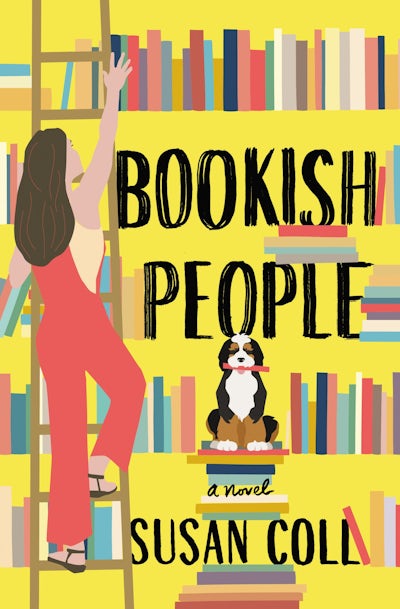
TBR: Bookish People by Susan Coll

TBR [to be read] is a semi-regular, invitation-only interview series with authors of newly released/forthcoming, interesting books who will tell us about their new work as well as offer tips on writing, stories about the publishing biz, and from time to time, a recipe. 


Give us your elevator pitch: what’s your book about in 2-3 sentences?


A vacuum cleaner, events in Charlottesville, a solar eclipse, a couple of Yiddish jokes I stole from my husband, and an independent bookstore came together to inspire Bookish People. A screwball comedy set in Washington DC during one soggy August week, the novel captures the spiritual depletion of a recently widowed bookstore owner and her overeducated, underpaid crew of booksellers. They are caught in the middle of a controversy: A reviled British poet who is scheduled to appear at the store has just been cancelled because of his misogynist behavior. What is a progressive bookstore owner to do?


Which character did you most enjoy creating? Why? And which character gave you the most trouble, and why?


I have begun answering this question about six times now, and I’m still not satisfied with the answer. I feel I ought to say that I most enjoyed writing Sophie, the bookstore owner, or Clemi, the events manager, both of whom I can relate to, and who I understand intuitively because they are each, in a way, a little bit of me. But in the end, I confess that I had the most fun writing Raymond Chaucer, the misogynistic poet who, in the pages of this book, is on one long bender. He’s on tour for his new poetry collection, and he’s been cancelled before being cancelled was even a thing. The reading public believes that he is responsible for his wife’s suicide, and he’s being compared to Ted Hughes. Fun fact: Raymond appeared in my previous novel, The Stager, in the context of his other, other family. He has a complicated life.


Raymond was also the most difficult character to write. I worried that he was too dark, and that he might alienate readers. My editor suggested cutting his point of view, which I did, but then I found I missed him, so I wound up sticking bits of him back in.


Tell us a bit about the highs and lows of your book’s road to publication.


It’s never easy, this publishing thing, and each book is its own challenge. I had the same agent for nearly 20 years and had also worked with the same editor for more than a decade.  My editor’s namesake imprint folded, and I switched agents, all of which was somewhat traumatic. Also my timing wasn’t the best—shortly after the book went out on submission, the pandemic began, and for months I didn’t hear anything. But in the end serendipity prevailed: My new agent learned about a new imprint at Harper, and he sent the manuscript off.  I am incredibly fortunate to have found an amazing editor who made this a much stronger book and am grateful for this fresh start.


What’s your favorite piece of writing advice?


It sounds cliché, and it is cliché, but write because you love to write, and because you have to write, and because you love the bookish life, and not because you think the outcome will be life-changing. Even if the stars align for you and your book, the challenges will keep coming, and it’s important to stay centered and remember why one writes.


My favorite writing advice is “write until something surprises you.” What surprised you in the writing of this book?


I love that advice! In my previous novel, The Stager, I was taken by surprise when the pet rabbit in the book began to talk. I used to roll my eyes when I heard authors say that their characters took on lives of their own, but in this case the rabbit quite assertively inserted himself into the narrative and had a lot of things to say. I had a similar experience in Bookish People, when the vacuum cleaner developed a distinctive personality. Ditto for the Russian Tortoise, Kurt Vonnegut Jr. I suppose the common thread here is that animals and inanimate objects ought not be underestimated in their supporting roles.


What’s something about your book that you want readers to know?


I hope readers come to the book understanding that it’s intentionally screwball, with a lot of manic action and zaniness.


Inquiring foodies and hungry book clubs want to know: Any food/s associated with your book? (Any recipes* I might share?)

There is, alas, a lot of unhealthy food: Buffalo Ranch Pringles and French fries are consumed, as is craft beer and a couple of skim cappuccinos.

Two party scenes feature distinctive alcoholic beverages: Malort, a famously foul-tasting spirit from Chicago, is chugged in the opening scene. The penultimate chapter features a solar eclipse cocktail called Penumbra Punch, which includes three different kinds of rum from a private Bermuda reserve, pineapple juice, and grenadine. There might be more ingredients, but my character is interrupted mid-sentence, so we’ll never know what else is in there.


****


READ MORE ABOUT THIS AUTHOR: www.Susancoll.com


ORDER THIS BOOK FOR YOUR OWN TBR STACK: https://www.politics-prose.com/book/9781400234097


Monday, March 14, 2022

TBR: The Lost Son by Stephanie Vanderslice

TBR [to be read] is a semi-regular, invitation-only interview series with authors of newly released/forthcoming, interesting books who will tell us about their new work as well as offer tips on writing, stories about the publishing biz, and from time to time, a recipe.


Give us your elevator pitch: what’s your book about in 2-3 sentences? (If this is too many sentences, you can cut the first one)


How does a mother survive the unsurvivable? After her husband and the baby’s nurse kidnap her infant son, Nicholas, and take him back to their native Germany, Julia Kruse must completely rebuild her life in America. The Lost Son chronicles Julia’s journey from Depression-Era Queens, NY through World War II as she struggles to provide for herself and her remaining son, Johannes. Over the years, her search for Nicholas is thwarted at every turn, until she falls in love with chauffeur Paul Burns, whose boss might have the political connections to find her son and bring him home from the German front during the last days of the Third Reich, where Johannes is also fighting for the Allies.


Which character did you most enjoy creating? Why? And, which character gave you the most trouble, and why?


I really enjoyed creating Paul. I just decided that for my main character to fall in love with someone after everything she’s been through in her first marriage, he’d have to be pretty special. Probably Nicholas, the younger son, gave me the most trouble, because he grew up in Germany. Even though I read a lot of memoir and history about Germany between the wars, it was hard to get him to come through authentically. I hope I was successful.


Tell us a bit about the highs and lows of your book’s road to publication.


Oh boy. Well, the book got me my agent, Anne Bohner at Pen and Ink Literary in 2012. You read that right. 2012. She sent it on submission twice, to an A list and a B list. There were some near misses but it didn’t land. After that she freed me to submit to independent presses. I spent the next several years submitting to contests and small presses and again, came coming close and shortlisting for awards several times. The closest came in spring 2018 when I submitted to a press where the editor said no and then a month later contacted me and said he was still thinking about the book while he was reading other submissions, that it had stayed with him. He said he wanted to talk about some suggestions with the upshot being if I took those suggestions, he’d look at it again. My agent said she doesn’t normally recommend someone do revisions without a contract but it wouldn’t hurt to talk to him. So we had a nice phone conversation. I actually thought his suggestions, which were substantial, sounded like they would improve the book. So I dove back in and did another revision, mostly to the second half of the book. Sent it back. He still said no but that he was sure he would find a place somewhere. I need to send him a copy.


I submitted to Regal House right at the beginning of the pandemic. Jaynie Royal, the publisher there, responded positively at every step of a rigorous submission process. I had also submitted to a teaching press in Baltimore at the same time and suddenly they wanted it as well. So I went from years of “not quite” to two yeses simultaneously. With the help of advice from my agent, I chose Regal House. I’m so glad I did. They’re a fantastic press.


What’s your favorite piece of writing advice?


Not surprisingly, given that story: “never give up.” Persistence has gotten me pretty far in this field. I remember saying over and over for the past ten years, “I would give up on this book but it keeps coming so close.” Now I’m glad I didn’t. Also, the process of writing is really what matters if you’re a writer, what feeds you. Trying to get published is business. It feels good when you get a “yes” but it won’t feed you. Ultimately, you have to enjoy the process.


My favorite writing advice is “write until something surprises you.” What surprised you in the writing of this book?


The character of Johannes, Julia’s oldest son, who grows up in the course of this book. I also had fun writing him. Funny things he would do or say. I got one of his remarks from a story in a 1930’s Catholic elementary school textbook which I just happened to pick up at a flea market (I LOVE flea markets).


What’s something about your book that you want readers to know?


The Lost Son is very loosely based on something that actually happened to my step-great grandmother, Julia. I didn’t find out she was actually my step great-grandmother until I was in my early 30s. I learned how she and my grandfather, Jacob, married in the mid-1940s in what was a second marriage for both, a late-in-life love. At the time I was the mother of two young boys myself and I couldn’t imagine how my stepmother endured the loss of her youngest son as an infant. I thought about her a lot over the years. I also decided that my great grandfather must have been a special person for her to have overcome such a betrayal and remarry.


Inquiring foodies and hungry book clubs want to know: Any food/s associated with your book? (Any recipes* I might share?)


Absolutely. Food is a big part of this book; Julia is a pastry chef whose father was a renowned chef. She works at a bakery. So German foods like brotchen (morning rolls), sauerbraten, and bread play a big part. The novel takes place in Queens in the 20s-40s, when German, Italian, and Irish immigrants were the main population. There were German restaurants everywhere. I mentioned Gebhardts, where Julia and Paul go for their first date, and which is a real restaurant my grandparents brought me to a lot as a kid. I also mention egg creams often, which were a big part of the soda fountain culture in New York at that time. But I will leave you with my husband’s family’s French bread recipe, which Julia finds great satisfaction in making, as do I.


Vanderslice Family Bread

Yield:              8 loaves                      4 loaves          2 loaves

                        2T salt                        1T salt            ½T salt

                        2T sugar                     1T sugar         ½T sugar

                        2T yeast                     1T yeast         ½T yeast

                        9-10 c flour                5-6 c flour      2-3 c flour

                        5c warm water          2 1/2c warm water   1 ¼ c warm water

                        olive oil


Combine yeast, salt and sugar with warm water in a large bowl.  Cover with a dishtowel and allow to proof for 5-15 minutes, the evidence of which will be bubbly biscuit-colored coating on top of the mixture.  Stir in flour 1-2 cups at a time until a stiff ball of dough forms.  Turn the dough out onto a floured surface and knead between 5 and 10 minutes, then place the dough ball in an oiled bowl in a relatively warm spot until it rises to double in bulk.  Rising will take between 1-2 hours but at this point you can just go about your day.  As my mother-law would say, bread is very forgiving.  The dough won’t take over your kitchen like the blob, or “fall” like a cake, so if you want to go to a movie, rake the lawn, take a long lunch with friends, feel free to do so.

When you’re ready to return to it, set your oven to 350 and while it pre-heats, punch down the dough on the same floured surface and divide it into eight, four or two balls of even-size size which you can then shape into long baguettes.  If you have a brush, you might brush the tops with a little milk or olive oil (I have come to prefer the latter). Place these on oiled, foil covered baking pans (if you get serious about this, you’ll probably want to invest in baguette pans; I was fortunate to inherit mine from my in-laws but baking pans are fine when you’re just staring out) and allow to rest/rise for another 10 minutes or so.  (My mother-in-law would be alarmed that I don’t let the baguettes rise for at least thirty additional minutes but I am usually under a time constraint at this point or just feeling impatient.  The loaves seem to come out the same.) Slash each loaf diagonally a few times with a sharp knife, then bake for forty-five minutes at 350.  Depending on the heat of your oven, if you’re cooking more than 4 loaves, you may need to switch out the loaves on the top and lower shelves of the oven midway through to make sure they cook evenly.  Loaves can be consumed immediately, with the rest frozen for reheating during the week.


 *****


READ MORE ABOUT THIS BOOK:

https://www.regalhousepublishing.com/product/the-lost-son/


ORDER THIS BOOK FOR YOUR TBR STACK:

https://www.regalhousepublishing.com/product/the-lost-son/


Tuesday, January 18, 2022

TBR: The Other Ones by Dave Housley

TBR [to be read] is a semi-regular, invitation-only interview series with authors of newly released/forthcoming, interesting books who will tell us about their new work as well as offer tips on writing, stories about the publishing biz, and from time to time, a recipe.


Give us your elevator pitch: what’s your book about in 2-3 sentences?


The Other Ones is a book about a group of people whose fellow office workers win the lottery. The novel follows the people who did not win (aka, the other ones), and the ways they react to this rather cataclysmic event, for better or (mostly) worse, over the course of a year.

 Which character did you most enjoy creating? Why? And, which character gave you the most trouble, and why?


There’s a character named after Peter Gibbons, who is the main character in the movie Office Space, and he mostly sits at his desk and works on his fantasy football team or thinks about getting another cup of coffee or what he’s going to eat for lunch. There’s a section where he’s just running through all the possible lunch options, and I think that’s my favorite part of the entire book, and really the culmination of thirty years of me working in offices. He’s just entirely a creature of the office. We never see him in any other situation and it’s only hinted at that he has a life outside of the building. I wrote him in after an agent gave me the feedback that there was too much office stuff in my office novel, so I leaned in and wrote a character who only exists in the office, at his desk and the break room. This is, also, one way to not get an agent. I love Gibbons, though, and I think he’s hopeful and wistful and I’m really rooting for him. He recites a poem by my friend, the great writer Meghan Phillips, called "Yellowshirt Elegy," which is from the point of view of one of the worker bee “yellowshirts” in Star Trek, part of which goes ”the heart of the ship, the heart of the ship, you are working in the heart of the ship.” In many ways I think Gibbons is the heart of the Other Ones ship.


 Tell us a bit about the highs and lows of your book’s road to publication.


Have you heard about the global pandemic? Does everybody whose books have been published in the past eighteen months say that? So that’s actually the second part. I signed a contract with Alan Squire Publishing in early March 2020, just before the last in person AWP, and then the pandemic went into full boil and two weeks after signing a contract for my office novel none of us were working in offices anymore.


Prior to that it was kind of a long road. I’ve written a lot of strange books, and I try to be honest with myself about the potential marketability of, say, a book about two old men sitting outside an abandoned factory waiting for their jobs to come back (my novella Howard and Charles at the Factory) or a book of short stories that all end in a massive cleansing fire (my collection Massive Cleansing Fire). But I thought this book was marketable. I thought it was an agent book. I remember talking to you about it, which must have been AWP 2019, and feeling like this is the one book I’ve written where there actually is an elevator pitch and it doesn’t sound ridiculous, where I don’t feel kind of like an asshole telling somebody what this book is about. So I did the agent query thing with it, and I felt somewhat confident that I might at least get some interest, and it just…didn’t happen. A few people read it and passed, for various reasons. I kept on querying and kept on getting rejected or just ignored – the agent thing is brutal, even for somebody like me who is pretty clear-eyed, I think, about the process, and has developed a thick skin about being rejected. You learn to live with the call (submission) and response (rejection), but the agent thing is more like call (query) and…just nothing. At a certain point this had gone on for months and I realized I was just blind-querying and it could go on forever – literally, I could still be doing it right now, with maybe a thousand rejections or non-responses behind me. So I turned to small/medium presses that had open calls for submission, and Alan Squire happened to be open. It had been rejected by maybe ten or so other presses by that time, and I was starting to get my head around the idea that this might just never connect with a publisher when they accepted it. They’ve been an absolute joy to work with, just really great, and they’re pushing very hard to get the word out about it, so in the long run I’m very happy with how it all played out, but like I said, it was a long and very unsure road.  


What’s your favorite piece of writing advice?


I’m a big butt in the chair person. I think its just work. For me writing is like exercise – you just have to do it, there’s nothing mystical about it, just elbow grease. I think my own advice to people is that you don’t need a lot of time, you don’t need a big desk in a summer house by a lake and days stretched out in front of you to write. I write a lot on lunch breaks. I go to breakfast on the weekends and write. Last night I went and had a Manhattan by myself at a bar and wrote a thousand words. Sit down and write. The thing about driving at night is true. You can only see in front of you but you can get all the way home.


My favorite writing advice is “write until something surprises you.” What surprised you in the writing of this book?


A few things. The ending kind of came together in a way that I never would have predicted. I don’t want to spoil it but a few of the pieces that I put on the table just kind of fell into place and clicked together in a way that my conscious brain never thought about at all. I don’t outline anything, and I don’t think too much about how the pieces will fit together as I’m writing a first draft, at least, which is not a terribly efficient way to write, but the only way I know how. And I remember sitting in the coffee shop writing the ending and thinking holy shit this is actually just kind of falling into place, the ghost and the guns and the gala.


That’s a teaser. That’s some marketing right there.


It was really interesting editing this book, because like I said I wrote most of it over lunch breaks while I was working in my office, and then I edited it while we were all working from home. I imagined that I was kind of skewering the office setting in general, and there’s definitely a lot of dark humor in the book, a lot of things that have annoyed me over thirty years of working in offices are in here. But the surprising thing to me was that there’s a lot of heart in there, too. There’s one character in particular who really leans into her work, and she, along with Gibbons, who sits at his desk and thinks about lunch, really became the heart of the book in a way that I didn’t see when I was writing it.


What’s something about your book that you want readers to know?


I want readers to know that this book is very much a direct result of my very real fear that I would forget to play the office lottery one week and would walk into the building to hear the sounds of celebration. This is the first scene in the book. When we were working in the office – I’m the Director of Web Strategy for Penn State Outreach and Online Education – I always played the lottery with our office group and it was 100% about that fear of missing out and the question of what would it be like if these other people actually won the lottery. It’s almost like a rapture-like event. How could you keep on going if you knew that you could have been raptured if you had only just remembered to throw a few dollars into the pot? That was always a fear of mine and it’s what the people in this book are wrestling not so gracefully with.


Inquiring foodies and hungry book clubs want to know: Any food/s associated with your book?


Mostly donuts. Offices are big on donuts. One of the things I miss about the office is the shared foods that you probably wouldn’t care about at all if they weren’t sitting there in the break room and free. Donuts and bagels and cookies.


READ MORE ABOUT THIS AUTHOR: www.housleydave.com


READ MORE ABOUT THIS PUBLISHER: https://alansquirepublishing.com/


ORDER THIS BOOK FOR YOUR TBR STACK: https://bookshop.org/books/the-other-ones-9781942892304/9781942892304


READ AN EXCERPT, “Did You Play?”: https://therumpus.net/2021/10/rumpus-exclusive-did-you-play/


Work-in-Progress

DC-area author Leslie Pietrzyk explores the creative process and all things literary.