Monday, May 24, 2021

TBR: Negative Space by Lilly Dancyger


TBR [to be read] is a semi-regular, invitation-only interview series with authors of newly released/forthcoming, interesting books who will tell us about their new work as well as offer tips on writing, stories about the publishing biz, and from time to time, a recipe!


Give us your elevator pitch: what’s your book about in 2-3 sentences?


Negative Space is the story of my father’s life, art, heroin addiction, and death—as well as the story of the decade I spent piecing together the truth of who he was by interviewing people who knew him, reading his notebooks and letters, and studying his artwork. There are images of his artwork throughout, and I think of it as a hybrid art book/memoir, with an investigative journalism bent.


What boundaries did you break in the writing of this memoir? Where does that sort of courage come from?


Negative Space breaks genre boundaries by bringing art and journalism into memoir—and it breaks the fourth wall by including the story of how the book came to be in the book itself. I don’t think writing about the writing of a book in the book always works, but it felt necessary here, to show how my relationship to the artwork and to the process of interviewing people who knew my father changed over time. At first I thought I could maintain the cool distance of a reporter, but the story inevitably swept me away and required me to engage with my own grief and anger.


Tell us a bit about the highs and lows of your book’s road to publication.


There were a lot of lows! I racked up more than 50 rejections over seven years of querying, and when I finally got a book deal, I ended up canceling it. Then I had another brutal round of rejections (during which I also acquired and then fired an agent) before Negative Space was finally selected by Carmen Maria Machado as a winner of SFWP’s 2019 Literary Awards. I wrote about this saga in detail for Electric Literature if anyone wants the whole story.


What’s your favorite piece of writing advice?


I don’t think I have one! I don’t really believe in maxims, and I think most of the truisms out there about writing end up being limiting. There are so many prescriptions out there about how to be a writer and how to write the “right” way. Most of the process of finding my own voice and routine as a writer has been about unlearning all of the external rules and advice, and getting in touch with what comes naturally to me, and what works for my way of thinking, and working, and expressing myself. I’ve never been a “write every day” writer, for example, and for years I beat myself up over that. I thought I was failing somehow because I didn’t write the way I was “supposed to,” but when I finally stopped trying to force myself into a routine that just didn’t work with my life, I found a much more productive schedule that works for me and allows me to enjoy writing rather than feeling like I’m doing it wrong. (I work in sporadic, intense bursts.)


My favorite writing advice is “write until something surprises you.” What surprised you in the writing of this book?


I was surprised to discover how much anger was hiding underneath my grief over my father’s death. Confronting that and letting it complicate the story was a big shift for me personally, and for the direction of the story. I think going through that process is what prepared me to edit my anthology, Burn It Down, in which so many other writers engaged with anger that was hiding under other emotions, or other emotions that were hiding under anger.


How did you find the title of your book?


Titles are so hard! For a long time, the working title of this book was Hunter/Hunted, after a series of deer sculptures and prints that my father made. The concept behind that series ended up being really central to the book, and I came to think of the book as almost a continuation of or response to that series, so I wanted to use the title. But eventually I realized that it only made sense after reading the book, and people I polled seemed confused by it without the context. So I started thinking about artistic principles that were important to both my father’s work and my book, instead, and Negative Space just fit since I was writing around the absence of my father. There’s also a story in the book about how he explained the concept of negative space to me when I was a kid and he was teaching me how to draw that also encapsulates so much of what I was trying to do with the book, but I won’t spoil it.


Inquiring foodies and hungry book clubs want to know: Any food/s associated with your book?


Not that I can think of… (the only food I mention in the book is from specific restaurants my family used to go to, as opposed to stuff we made at home!). But if pressed, I guess maybe matzoh ball soup with lots of dill.


*****


READ MORE ABOUT THIS AUTHOR: https://www.lillydancyger.com/


ORDER THIS BOOK FOR YOUR OWN TBR STACK:  https://bookshop.org/a/1925/9781951631031


READ AN EXCERPT FROM THIS BOOK, “Making Art Out of Dead Things”:  https://bombmagazine.org/articles/lilly-dancyger-negative-space


Monday, May 17, 2021

TBR: Lucy Clark Will Not Apologize by Margo Rabb

TBR [to be read] is an invitation-only interview series with authors of newly released, interesting books who will tell us about their new work as well as offer tips on writing, stories about the publishing biz, and from time to time, a recipe. 


Give us your elevator pitch: what’s your book about in 2-3 sentences?


Lucy Clark Will Not Apologize is an Agatha Christie-meets-The Secret Garden tale. It’s the story of a girl whose life is transformed by a garden and a mystery, and through these challenges, she discovers an inner strength she didn’t realize she had.


Which character did you most enjoy creating? Why? And, which character gave you the most trouble, and why?


One of my favorite parts of writing this book was the research I did—part of the novel is set in a fictionalized version of one of my favorite places, a real-life garden called Chanticleer outside Philadelphia. I interviewed a horticulturist there, Chris Fehlhaber, for research, and we had many long, philosophical conversations about the meaning of gardens and how they can change our emotions. These interviews helped shape several of the characters in the book, including Lucy, Edith, and Mimsy. I also wrote this essay about the experience for The New York Times. Writing is never easy for me, so I think creating every character—and every page!—is a combination of joy and trouble for me.


Tell us a bit about the highs and lows of your book’s road to publication.


I spent over five years writing this novel, but the hardest part of the whole process was doing the last revisions during the pandemic, with my two children home in remote school and my husband working from home also. I’ve never before had a more challenging time to write—there were constant interruptions, and to be able to focus, I wrote outside in the backyard a lot, hiding behind the garage. I also wrote in my children’s playhouse, in a tent in the backyard in the rain and snow, and sometimes I’d wait until after everyone went to bed, and I’d write until two or three o’clock in the morning. A few times, when I was working through whole drafts for copyedits, first pass, and second pass pages, I’d stay up the whole night, all the way till 8 o’clock the next morning. The crazy thing is, I actually enjoyed staying up all night so I could have that uninterrupted time. I hadn’t pulled all-nighters like that since college.


What’s your favorite piece of writing advice?


My favorite advice is from Lynda Barry, who quotes her own teacher Marilyn Frasca--when Lynda was complaining she didn’t like her own work, Marilyn told her: “It’s none of your business.” I love the idea that how we judge or feel about our own creative work doesn’t matter—what matters is the process of making it.


My favorite writing advice is “write until something surprises you.” What surprised you in the writing of this book?


My favorite chapter is one in the middle called “Sea Change.” Writing it was one of those moments when it sort of just poured out. It felt like it came from the deepest part of me.


How do you approach revision?


All my best work happens in revision. I do very messy, long first drafts, often handwritten, and then I edit the hell out of it for years. Even with shorter pieces like essays or book reviews, I spend an enormous time editing and revising. I also keep handwritten notebooks for all the characters in my novels, to get to know them better. Little bits and pieces of writing from the notebooks always do end up in the final book. 


Inquiring foodies and hungry book clubs want to know: Any food/s associated with your book? (Any recipes I might share?)


Food is a huge part of Lucy Clark—part of her journey in New York is eating many delicious things she’s never had before, and having a sort of awakening through food. There’s a meal in the chapter “Sea Change” that’s at a fictional cafĂ© that’s based partly on two restaurants I love: Buvette in the West Village, and also it’s based on a life-changing meal I had at Curtis Duffy’s Grace restaurant in Chicago. Here is the chef at Buvette making “Anchoiade Tartines”—they’re very simple, with butter, anchovy, and caper berries. They’re delicious!


https://www.marthastewart.com/867796/anchoiade-tartine

*****

READ MORE ABOUT THIS AUTHOR: www.margorabb.com


BUY THIS BOOK FOR YOUR OWN TBR STACK: Signed and personalized copies can be ordered and shipped here from one of my favorite indie bookshops: http://www.childrensbookworld.net/rabb-lucy-clark-will-not-apologize/


Wednesday, May 12, 2021

TBR: Wait for God to Notice by Sari Fordham

TBR [to be read] is a semi-regular, invitation-only interview series with authors of newly released/forthcoming, interesting books who will tell us about their new work as well as offer tips on writing, stories about the publishing biz, and from time to time, a recipe!


Give us your elevator pitch: what’s your book about in 2-3 sentences?


Wait for God to Notice is about growing up in Uganda during and after the dictatorship of Idi Amin. It’s also about a daughter getting to know her Finnish mother while considering their shared past.


What boundaries did you break in the writing of this memoir? Where does that sort of courage come from?


I broke boundaries with point of view. When we first moved to Uganda, I was about one and a half years old. I have a good memory, as everyone in my family will tell you, but it doesn’t go that far back. To write about our arrival, I had to sort of hover over our family, much like a fiction writer would, using material I gathered from interviews, photographs, letters, newspaper articles, visits back to Uganda and of course the stories I had heard my parents tell. The challenge was finding a nonfiction voice that allowed me to inhabit that space and write honestly and authentically. The older I get in the narrative, the more fully I inhabit my point of view, but occasionally I make the imaginative leap into another perspective. My favorite was briefly considering our family from the perspective of the monkeys who were harvesting the tomatoes from our garden.

The courage came from reading memoirists who successfully did the work I was trying to do. I returned to Running in the Family by Michael Ondaatje and Out of Egypt by André Aciman over and over again. The courage also came from the urgency I felt to write this story.


Tell us a bit about the highs and lows of your book’s road to publication.


Completing this book took a lot longer than I expected. I got a job. I got married. I had a kid. Lots of good life stuff happened, none of which lent itself to long stretches of writing time. I shifted over to writing essays because they were more manageable. They had the added advantage of helping me rediscover all the things you can do with form, and I was able to return to my book manuscript and solve the structural problems I had encountered.

Sometime after I completed my manuscript, I noticed one of my Twitter acquaintances had a book published with Etruscan Press. Intrigued, I visited the Etruscan website and saw they were publishing 50 Miles by Sheryl St. Germain. Sheryl was my professor at Iowa State University. Etruscan had an open call for submissions and so I sent in my manuscript, which they accepted. Their executive director, Philip Brady called me on the phone before I signed the contract, and he talked about my memoir exactly the way I wanted readers to think and talk about it. And that was that.


What’s your favorite piece of writing advice?

I like Pico Iyer’s advice, “I think writing is really about a journey of understanding. So you take something that seems very far away, and the more you write about it, the more you travel into it, and you see it from within.”

My favorite writing advice is “write until something surprises you.” What surprised you in the writing of this book?


The book’s final structure surprised me. I had planned to move back and forth between Uganda and Finland, which sounds great, but I couldn’t make it work. There just wasn’t enough happening in the Finland sections to justify my original structure. I transitioned over to a disrupted chronological structure that focused on three separate parts—each with its own theme--and that allowed me to move deeper into the narrative.


How did you find the title of your book?

This book had a lot of different titles, none of which felt right. Julie Schumacher, who was my writing teacher at University of Minnesota, advised me to read through my manuscript draft and underline every phrase that caught my eye. I underlined like a freshman in college—so much underlining—and then I came to a line from one of my mother’s letters and I knew that was it. She wrote, We just found out that the price of one roll of toilet paper is $5.00, and its size is not enough to use a dozen times. I’ve read that the sellers rarely have bananas and beans. Wait for God to notice.


Inquiring foodies and hungry book clubs want to know: Any food/s associated with your book? (Any recipes I might share?)

In my memoir, I write about how Idi Amin put our family under house arrest, and how after he had walked back his threats, my mother used all the rice and flour in the house to make piirakka, a Finnish staple and an extraordinary treat since food was so scarce. My father was in Kenya during the house arrest and she was hoping he would smuggle some flour over the border—which he didn’t—but he was alive and we were alive and we all ate piirakka.


In Finland, piirakka is eaten daily. Most households buy them from a store or bakery because they’re so time consuming to make. After my mother died, I spent years trying to replicate her recipe, which she had carried in her head, and for a long time, I was very unsuccessful. I now finally have a good recipe and I make piirakka for Thanksgiving and Christmas. My piirakka looks rustic, but I know my mother would say it’s delicious. 

This link is a good one: https://www.saimaalife.com/recipe-finnish-karelian-pies/


*****


READ MORE ABOUT THIS AUTHOR: https://www.sarifordham.com/


ORDER THIS BOOK FOR YOUR OWN TBR STACK:  https://bookshop.org/books/wait-for-god-to-notice/9781733674157


READ AN EXCERPT, “Driver Ants”:
https://www.creativenonfiction.org/brevity/past%20issues/brev20/fordham20.htm


Monday, April 26, 2021

TBR: All These Hungers by Rick Mulkey

TBR [to be read] is a semi-regular, invitation-only interview series with authors of newly released/forthcoming, interesting books who will tell us about their new work as well as offer tips on writing, stories about the publishing biz, and from time to time, a recipe!  


We don’t expect an elevator pitch from a poet, but can you tell us about your work in 2-3 sentences?


I’ve often thought of a passage by George Eliot: “It seems to me we can never give up longing and wishing while we are thoroughly alive. There are certain things we feel to be beautiful and good, and we must hunger after them. How can we ever be satisfied without them until our feelings are deadened?” In many ways, All These Hungers explores this same paradox of desire as a hunger for its own continuation, and how the role of hunger and consumption in its many forms shapes our personal stories and our relationships with family, friends, the natural world, and even our approach to politics and religion.


Which poem/s did you most enjoy writing? Why?


The poem I most enjoyed writing was “Cured.” First, I don’t know that I’d ever written a poem addressed to a specific person. I’ve written poems about individuals, and poems in which the “you” existed and was addressed, but that “you” was often a mixture of several people or an imagined individual or audience more than a single person directly addressed. Plus, “Cured” was the poem that brought together several of my interests in this collection: the region of the country, Southwest Virginia, where I was born and raised, the role of religion and the spiritual in our lives, the ways in which we are all connected by our hunger for food and drink, for acceptance and friendship, for love. It is a political poem, but, I hope, not too overtly political. Plus, it is a poem about bacon.


Tell us a bit about the highs and lows of your book’s road to publication.


I write very slowly. I’m not someone who can complete a poem in a couple of hours. It can take me days, even weeks. In some cases, I may come back and work on a poem over months or even years before I’m done with it. So, the lows for me almost always have something to do with whether or not I’ll finish a collection. It is always a multi-year process for me. As for the book’s road to publication, I find the submission process the most stressful. Each of my previous books was published by a different press, so once I finish a manuscript, I have this sense of dread about the submission process and having to start that all over again. When I first began sending this manuscript out, I sent it mostly to contests, and almost immediately it was selected as a finalist at a couple of those contests, so I thought acceptance and publication might happen quickly. But it didn’t. Before I knew it, I was nearing the date that would start the second year of submission, and I was feeling pretty low about the situation. Then, fortunately, three different publishers showed interest, and now the book is out in the world. Of course, now that this book is published, I can start worrying about whether or not I’ll write another one.


What’s your favorite piece of writing advice?


Since I’ve made a living as a writing teacher, I’ve given lots of writing advice over the years. But the one piece I always come back to is to read as much and as widely as you can. I can’t stress how important this is. I read poetry, fiction, especially short fiction, nonfiction, science, history, and biography. All of it informs me, and I hope it makes me a better writer. No one can be a successful writer without reading actively and obsessively. In this age of technology and social media, it is too easy to overlook the importance of informed, careful reading. I think it is valuable to know the best contemporary writers, but also know that body of literature that precedes us. The best writers I’ve known have always been some of the best and most avid readers, too. Beyond that, however, the greatest obstacle is lack of perseverance. Desire and energy make up for many shortcomings in terms of natural ability. It helps to have talent, but willpower and drive can carry us through lots of inevitable disappointments and rejections.


My favorite writing advice is “write until something surprises you.” What surprised you in the writing of this book?


What surprised me most in the writing of this book is how often I went to closed forms to find my way into a poem. While the end product isn’t always a sonnet, villanelle, or pantoum, several of these poems are in those forms, and other poems are influenced in some way by various forms. “Velveeta” uses a variation on rhyming quatrains, for instance. I was reading lots of Metaphysical and Romantic poets during the years I worked on this collection, and perhaps that had some impact on the way I thought of form, too.


How do you approach revision?


For me the most enjoyable aspect of writing is revision. I’m generally horrified by having to start a new poem. I envy novelists who have a general idea of where they are going with their writing each day they go to work on the book. With each poem, I’m starting all over again with all the fear and self-doubt that a new start brings with it. Plus, I rarely have a clear vision of the poem when I begin a new one. I mostly start by obsessing over a sound or image, or there is a sentence or phrase I have stuck in my head, but I don’t know where this might lead me. This is why I love the revision process. Once the first draft is completed, I can go back and work on a poem without that fear of the blank page, and with the solace of knowing I have a place to start the day’s work and a direction to explore.


Inquiring foodies and hungry book clubs want to know: Any food/s associated with your book? (Any recipes I might share?)


As you might guess, a book titled All These Hungers has lots of food references and associations. While the book deals with plenty of subjects that aren’t food related (dung beetles, for instance), you’ll find poems about bacon, whisky, peaches, pickles, and one of my favorite dishes, haggis, in a poem titled “In Defense of Haggis.”  People who’ve never tried it are horrified by the idea of haggis, but I’ve been eating it since my trip to Scotland many years ago for a writing residency at Hawthornden Castle. Because of certain U.S. regulations, it isn’t possible to have real Scottish haggis shipped to the U.S., so I’ve discovered a couple of recipes that I can make at home. I’ll share one for a very simplified version of haggis that is quite different from real haggis but is remarkably close to the texture and taste of the real thing. I hope you’ll give it a try with some mashed potatoes and mashed rutabaga, and a glass of your favorite single malt scotch.


*Simple Haggis

Ingredients

·      1/2 tbsp butter 

·      1 large onion

·      1 tsp ground black pepper (I add a little more because I like mine very peppery)

·      3/4 tsp ground coriander

·      1 tsp nutmeg

·      1 tsp allspice

·      3/4 tsp dried thyme or fresh, slightly chopped if fresh

·      1/2 tsp cinnamon

·      1 lb ground lamb 

·      ½ lb chicken livers (ground or chopped)

·      1 cup stock (I use chicken, but I think vegetable would work, too)

·      4 oz pinhead oatmeal (I sometimes toast this but it is ok if you don’t)

Instructions

1.          Preheat the oven to 350F.

2.          Warm the butter in a pan. Finely dice the onion and cook over a medium heat in the butter until softened, about 5-7 minutes.

3.          Meanwhile chop the chicken livers. Sometimes I will mince them in a food processor.

4.          Add the spices and thyme to the onion and cook a minute then add the ground lamb and chicken livers.

5.          Brown the meat. Once it cooked through, add the stock and cover. Simmer for around 20-25 minutes.

6.          Next, add the oatmeal, mix well and transfer to an oven dish (I use a cast iron Dutch Oven so I don’t have to worry about this step, but any oven proof dish will work.)

7.          Cover the dish and put in the oven for 30 minutess.

8.          Remove the lid and cook another 10 minutes.

9.          Serve with mashed potatoes and mashed rutabaga.

10.        *This is adapted from a recipe from Caroline’s Cooking. There are also plenty of good vegetarian recipes available online, too.


*****

READ MORE ABOUT THIS AUTHOR:  www.rickmulkey.com


WATCH VIDEO OF THIS AUTHOR READING: https://fb.watch/4IeTE09Qvr/


BUY THIS BOOK FOR YOUR TBR STACK:  https://www.amazon.com/dp/1950739031/ref=cm_sw_em_r_mt_dp_208PM1QYFGEWSEFHB7VA


READ AN EXCERPT FROM THIS BOOK: https://www.brickroadpoetrypress.com/rick-mulkey


Monday, April 12, 2021

TBR: An Inventory of Abandoned Things by Kelly Ann Jacobson

TBR [to be read] is a semi-regular, invitation-only interview series with authors of newly released/forthcoming, interesting books who will tell us about their new work as well as offer tips on writing, stories about the publishing biz, and from time to time, a recipe!


Give us your elevator pitch: what’s your book about in 2-3 sentences?


The book is a collection of linked stories that both tell the story of a pregnant graduate student separated from her wife and form an inventory of the Florida panhandle. The biggest question in the book is what it means to fight the land for a home, and how that fighting with a place can actually make you fall in love with it.


Which story did you most enjoy writing? Why? And, which story gave you the most trouble, and why?


My favorite story in the collection is probably “Insect Killer.” I love stories that challenge me, and “Insect Killer” contains three separate encounters with three separate kinds of ants, all serving as metaphors for different phases of the character’s time in Florida. So it’s my favorite story, and yet also the most challenging—kind of like the Florida landscape where I encountered all of those ants!


Tell us a bit about the highs and lows of your book’s road to publication.


This book was purely a work of personal art. I wrote it for myself—to document all of the strange and wonderful (and very terrible!) things I had experienced during my time in Tallahassee. It’s an interesting book in that it’s part nonfiction—almost all of the natural details are drawn from my time there—and part fiction, because the characters and relationships are completely fabricated. (Writing a story where the partner is 100% supportive does not make for good fiction!) Then I sent it off to some chapbook contests, since chapbooks are hard to publish outside of dedicated venues, and never really thought much about it. I love Split/Lip and have been a fan of theirs for many years, but I certainly didn’t think they would select my book! There are so many wonderful authors who submit! What a reinforcement of the idea that writers must first and foremost write for themselves, and write the stories that they need to tell, even if they don’t necessarily have a publication plan, because you never know whether a book will sell or whether it will sit on your computer for all of eternity. 


What’s your favorite piece of writing advice?


Writing should be fun. I certainly have written books that have challenged me or gotten me stuck for a while, but overall, I think that writing should be an enjoyable process—whatever that means to you. It’s not financially rewarding enough to spend time doing it otherwise. In my classes, I have my students do a ton of creative exercises, from acting out their battle scenes to drawing weapons on pieces of paper and then exchanging them. I have to break them out of their high school mindset of the five-paragraph essay, and out of their fear of producing something a teacher might tell them isn’t right. I want them to start at the point of silly-fun, and only after that, when they’re sitting there smiling at their papers, do I move them to emotionally-challenging-but-still-fun.


My favorite writing advice is “write until something surprises you.” What surprised you in the writing of this book?


The ending surprised me. I often don’t know the endings of my books—or I know only the beginning and ending but literally nothing between those two points. I don’t want to give anything away, but I wasn’t sure whether these characters would stay in Florida or not, and I was fascinated to find out what path they chose.


How do you approach revision?


So revision is basically my worst enemy. I hate it. I read about writers who describe how much they’ve come to love revision over time, and…I’m not one of them. I basically live in a book while I’m writing it, and then, when I finish it, it’s dead to me. This is not to say I think my books are perfect—far from it! I just am willing to write a book that doesn’t work, acknowledge that a few months later, and then put it in a computer folder, never to be read by anyone but me. If I really, really, really care about a book enough to revise it, I have to start the book over from the beginning. On the plus side, this makes me a very easy writer to work with during the editing process—an editor suggests a revision, and, having moved on and completely distanced myself from the work, I can apply that revision as suggested with very few exceptions. Some people use short stories to practice their craft—I just happen to use novels and collections as well.


Inquiring foodies and hungry book clubs want to know: Any food/s associated with your book? (Any recipes I might share?)


I wish! There’s an apple pie in the book, but it’s store-bought, which is an important detail in that story. I ate so many wonderful foods in my time down south—my favorite was the shrimp & grits and hush puppies from Jonah’s in Thomasville, Georgia, which is pretty close to Tally—but as a part-time single parent when my partner was in Virginia and full time PhD student, I didn’t have much time to cook!


***


READ MORE ABOUT THIS AUTHOR:  www.kellyannjacobson.com


ORDER THIS BOOK FOR YOUR OWN TBR STACK: https://www.splitlippress.com/an-inventory-of-abandoned-things


Monday, April 5, 2021

TBR: Worn by Adrienne Christian

TBR [to be read] is a semi-regular, invitation-only interview series with authors of newly released/forthcoming, interesting books who will tell us about their new work as well as offer tips on writing, stories about the publishing biz, and from time to time, a recipe!


We don’t expect an elevator pitch from a poet, but can you tell us about your work in 2-3 sentences?

Worn is a collection of Black love stories that all feature clothing in some way. “Love” here encompasses all kinds of love – agape, filial, and eros.


What boundaries did you break in the writing of this book? Where does that sort of courage come from?

The boundary I broke in writing this book is getting away from Black literature being largely rooted in trauma. For example, if you look on any bestseller list right now, you will see that every book written by a Black person is about the traumas of race. Even if you look, too, at Black authors who have won the major writing awards, the books they’ve won for are almost always about race. Worn explores the other side of the coin of the Black experience – the side that is not rooted in trauma. I found courage in Toni Morrison’s advice, “Write the book you want to read.” I wanted (actually, needed!) to read something about Black people that didn’t enrage me, or send me to my knees in tears.


Tell us a bit about the highs and lows of your book’s road to publication.

There hasn’t been a single low on my book’s road to publication. In fact, I’m in awe in how professional, skillful, and supportive Santa Fe Writers Project is. Working with Monica Prince and Andrew Gifford has been great.


What’s your favorite piece of writing advice?

 Am I allowed to give more than one? ;) Toni Morrison said, “Write the book you want to read.” Carolyn Beard Whitlow said, “When people are clapping, stop.” In other words, don’t write the sequel if the original was a major success. Major Jackson said, “Ass in chair.” In other words, sit your ass in that chair and write. Steven Pressfield said, “A professional stays on the job all day.” Chigozie Obioma said, “Read.” A writer should never write more than she reads.


My favorite writing advice is “write until something surprises you.” What surprised you in the writing of this book?

 I had no idea that what we wear (and don’t wear) is so political. The why of what we’re wearing runs way deeper than the what.


How did you find the title of your book?

Titles to me are important, just as names are important. I knew I wanted something that told the reader that the collection was about clothes. I was thinking I could call it either Worn or Woven, and two of my mentors – Kwame Dawes and Joy Castro – said emphatically “Worn!”


Inquiring foodies and hungry book clubs want to know: Any food/s associated with your book? (Any recipes I might share?)

Hahaha. That’s a very good question. I drank a lot of tea while writing this book. Decaf tea is a great substitute for wine if you want something with ceremony, but don’t want your sleep affected. Also, I’m absolutely in love with High Tea. It’s a great way to have a high-end experience for not high-end money.

Homemade chai: https://www.epicurious.com/recipes/food/views/homemade-chai-201226


***

READ MORE ABOUT THIS AUTHOR: www.adriennechristian.com


ORDER THIS BOOK FOR YOUR TBR STACK: https://www.sfwp.com/project/worn/


Monday, March 29, 2021

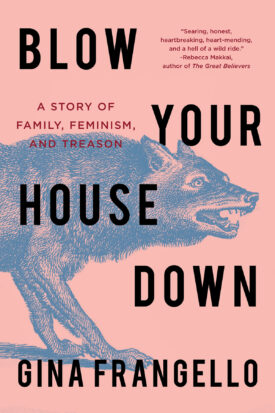
TBR: Blow Your House Down: A Story of Family, Feminism, and Treason by Gina Frangello

TBR [to be read] is a semi-regular, invitation-only interview series with authors of newly released/forthcoming, interesting books who will tell us about their new work as well as offer tips on writing, stories about the publishing biz, and from time to time, a recipe! 


Give us your elevator pitch: what’s your book about in 2-3 sentences?


Blow Your House Down centers on a time in my life when I was sandwiched in between parenting my three children and caretaking my elderly parents, all while my marriage was deteriorating, and I began having a passionate extramarital affair. After years of leading a double life, I finally left my marriage only to get diagnosed with breast cancer half a year into the new start I had imagined for myself—one that did not play out, in myriad ways, as I’d expected. Ultimately, the book explores, not only through my own experiences but through outside material about the medical, legal, psychological and economic treatment of women, the extent to which we still expect contemporary women to sacrifice our own needs and desires in order to be all things to others in our lives, and it’s about the consequences, both devastating and rapturous, that we face when we no longer go along with those expectations.


Which essay gave you the most trouble, and why? What boundaries did you break in the writing of this memoir? Where does that sort of courage come from?


My book is a bit of a hybrid between an essay collection and a memoir in that it’s told in distinct parts that are sometimes radically stylistically different from one another, but it has one cohesive story arc that drives all the pieces and unifies them into a whole ensemble piece larger than the disparate parts. To that end, the piece that gave me the most trouble was definitely the one in which my daughters discover my affair several months in by reading my texts, and my making the horrible decision—one that haunts me to this day—to allow them to hold that secret for years. It’s interesting…the boundaries I struggled with were all emotional, even though this is also my most formally innovative book. The story very much dictated to me the ways it wanted to be told, whether in the form of an invented dictionary or, in the opening piece “The Story of A,” a chronicle of how women’s infidelity has been treated historically. But emotionally, memoir is harrowing. I don’t know about where people find courage to write what they write, but for me, this was the book I had to write if I ever wanted to write anything else again, and it was also what I most urgently wanted to communicate to other women who might need a book like this, as I myself did when I was going through the experiences Blow Your House Down depicts. I think we all write the books we ourselves most wish we could have read, with the knowledge that if we desperately needed something, there are others out there who need that thing too.


Tell us a bit about the highs and lows of your book’s road to publication.


I’m working with Dan Smetanka at Counterpoint, who was also the editor on my last book, and the general Counterpoint team--such as the amazing Megan Fishmann who is the director of publicity--is comprised mostly of people I’ve worked with in the past, so in that sense this was probably my least harrowing road to publication. My first four books each came out on a different publisher, so it’s been wonderful, with my fifth, to be in a place that has become like a home and family to me. That’s especially awesome since in every other way, publishing a memoir is full of highs and lows. I’ve had some amazing responses months before the book’s publication from women who have written me letters that are so intense and urgent that they have literally changed my life already. But there’s also the part of me who is a person just living my life, who is separate from my character-self in the book, and it can be hard knowing that no matter how hard you try, there is simply no way to fully capture the complexity of either yourself or anyone else in your life through language, and that to readers we all begin and end with what is on the page—whereas in reality any memoir is just the visible part of an iceberg with most buried under the sea. So I would say the whole thing has been an exercise in remembering the boundaries of art and in letting go.


What’s your favorite piece of writing advice?


My least favorite piece of writing advice is that writers have to write every single day. It’s a thing I still see cited as an imperative in a surprising number of places. I think it’s great if someone can write every day, but I personally have always been a binge writer. Sometimes I don’t write for nine months or more. As someone with five books out, I wish I could shout from the rooftops that newer writers should give themselves permission to write in the rhythms that are right for them. On the other hand, the piece of writing advice that I give absolutely every student I have is to get involved in the literary community—to serve and support other writers and presses and indie bookstores and magazines in whatever capacity you can swing, rather than only looking to advance your own career, because the literary community has things to offer beyond just your personal publication credits. Almost every important relationship I’ve formed since my late twenties has come about through my work editing books and magazines and sites like The Rumpus and The Nervous Breakdown and now LARB. I tell my students to ask not what the literary community can do for them but what they can do for the literary community, because if we care about books that’s a thing that should matter to us. Economics and how busy we are definitely influence what kinds of contributions we may choose to make, but I think young writers who approach their careers as if their work and goals exist in a vacuum, rather than literature being an ongoing and intergenerational dialogue, are missing some of the most vital joys and fulfilments that the literary world offers.


My favorite writing advice is “write until something surprises you.” What surprised you in the writing of this book?


A lot of things surprised me, but probably nothing more so than how brutally honest I needed to be about the difficulties my former lover—who is now my husband—and I faced for almost two years after we “came out” as a couple. We are ecstatically happy now, and have been for a long time, but the people who told us, at first, that we had been in an “affair bubble” and that there was a big difference between the intoxication of a new and clandestine love versus being able to build an on the ground life together…well, those people were not wrong entirely. I mean, think that the happy ending of our still being together didn’t at first reveal to me how deep I would need to delve into the harder times that led here, which ultimately felt acutely necessary for writing an honest book. Because Blow Your House Down is not a primer on why you should have an affair and blow up your marriage …it’s no more advocating for that than it is advocating that women should stay in marriages that no longer fit them or that are actively painful to them. Rather, it’s an exploration of the enormous complexity in these choices, and the utter lack of guarantees in terms of what your life will look like when the dust of such a decision settles—what you will have lost and gained and learned along the way, and the fact that Life won’t stop and wait for you (nor, for that matter, will Death) while you figure it all out.


Who is your ideal reader?


My ideal reader is a woman of any age—and I’ll add here that I never before considered my ideal readers to be a specific gender, but while I hope men will also read and get something from Blow Your House Down, it was written first and foremost for women—who feels trapped inside the lines of who she thinks she is supposed to be versus who she actually is. Sometimes women get those messages very explicitly, from parents or husbands or from living in a particular kind of neighborhood or town or being a certain religion, but sometimes we just get these messages without even knowing we’ve internalized them, in which women are judged for virtually everything…certainly as a white heterosexual woman I’ve actually gotten off far easier than many women, who also have to deal with racism, ableism, homophobia or transphobia, with poverty far exceeding that I grew up in. The writer Kristi Coulter has written that there is “no right way to be a woman,” and that can become exponentially more true the more overlapping identities a woman may inhabit. I led a life for many years that often could not have been described as “unhappy” and that had many privileges and comforts, but in which I—increasingly over the years—felt like I was playing a part, and that I had to continue playing that part relentlessly in order to keep my whole family system functioning through a particular kind of nonstop emotional labor and walking on eggshells that I think is all too common in many women’s lives. Blow Your House Down is for every woman who has wondered what would happen if she stopped playing the part she believes herself consigned to. My hope is that it’s a complex exploration of what it means to begin living more authentically—acknowledging that I hurt people I truly cared about and owed better to along the way—and that it can help some women begin to reclaim themselves more mindfully than I did, but reclaim themselves nonetheless, for their own sake and their children’s and for a world that desperately needs us to stop towing old lines and to disrupt.


Inquiring foodies and hungry book clubs want to know: Any food/s associated with your book? (Any recipes I might share?)


My parents are major characters in the book and my father was an amazing cook. He was the youngest of seven brothers in an Italian family, and he did most of the cooking when I was growing up, and he made the best eggplant parmesan I’ve ever had—my mother learned to make it from him, and now I make it too. It’s all about pressing and salting the eggplant first, and slicing it thin, and what we fry it in before the baking…everyone who ever tastes it is converted even if they think they don’t like eggplant. But I’ve never actually followed a recipe, per se. I never saw my father even look at one. My daughters are much better at following recipes than I am, so their cooking repertoires are seemingly endless.


***


READ MORE ABOUT THE AUTHOR:  www.ginafrangello.org & www.circeconsulting.net)


ORDER THIS BOOK FOR YOUR OWN TBR STACK: I actually am partnering with Women & Children First in Chicago to donate my royalties for the book and a portion of sales through that store to the organization Deborah’s Place, which works with women facing homelessness:

https://www.womenandchildrenfirst.com/book/9781640093164


Work-in-Progress

DC-area author Leslie Pietrzyk explores the creative process and all things literary.