Monday, March 20, 2023

TBR: Saying Goodbye by Andrew Stancek

 TBR [to be read] is a semi-regular, invitation-only interview series with authors of newly released/forthcoming, interesting books who will tell us about their new work as well as offer tips on writing, stories about the publishing biz, and from time to time, a recipe. 


Give us your elevator pitch: what’s your book about in 2-3 sentences?


The book details a year in the life of a six-year-old Slovak boy being brought up by his grandparents in Soviet-era Czechoslovakia. In this novella-in-flash, filled with heartbreak and joy, betrayal and love, Adam grows through adventures with his grandfather in a quest for acceptance.


Which character did you most enjoy creating? Why?


As Grandfather guided me through his adventures with Adam, I grew to admire his strength. In Adam’s eyes he is heroic, almost mythical, but the reader comes to appreciate a life marked by poverty, wars, poor health, and, during the events of this story, a daughter who disappears, leaving a child behind. He is complex and the challenge was to present him as not just Adam’s superhero, but a living, loving, flawed human being.


Tell us a bit about the highs and lows of your book’s road to publication.


The book has been in the works for ten years; it has been envisioned as a full-length novel, as a collection of short stories, as a collection of novellas. Many parts have been reworked, many discarded. Once the publisher and I were happy with the format, we decided to race ahead toward an AWP 2023 Seattle launch, which became a marathon. Some authors who agreed to blurb could not meet that deadline. I am thrilled that Sara Lippmann and Nancy Stohlman juggled their schedules to provide generous praise.


A high has been holding the physical book in my hands, being able to sign and gift it to friends.


 What’s your favorite piece of writing advice?


1)    James Baldwin: “Discipline, love, luck, but, most of all, endurance. Write. Find a way to keep alive and write. There is nothing else to say.”


2)    Samuel Becket: “Fail better.”


My favorite writing advice is “write until something surprises you.” What surprised you in the writing of this book?


The process is mysterious. You must allow the characters to lead you, to let them tell the story. But a time eventually comes when that world can overwhelm, when the author feels the weight of too many stories and has to assume control. Aggressive characters can scream bloody murder.


What’s something about your book that you want readers to know?


A childhood is sorrow-filled. Soon after the events of this book, armies of the Soviet Union and three other nations crossed the borders with tanks, to occupy Czechoslovakia and chase Adam’s family and 300,000 other citizens out of the country. The Slovak large, even mythic, stories remain largely untold, although a few authors continue to till that soil.


Inquiring foodies and hungry book clubs want to know: Any food/s associated with your book? (Any recipes I might share?)


BREAD DUMPLINGS, STEAMED


 Ingredients:


1 loaf of day-old white bread

4 eggs

1 cup of milk

6 tablespoons of butter

Salt and pepper

4 tablespoons of parsley (optional)


Cut the bread into one-inch cubes.


Separate the whites and yolks of the eggs into two bowls.


Beat the whites into a stiff meringue with an electric beater.


Add the milk into the bowl with the yolks and beat.


Melt butter.


In a large bowl, using your hands, mix the bread, the milk with egg yolks, the melted butter and the parsley, salt, pepper. Gently fold in the egg whites.


Place a steamer on top of a pot, add water, just high enough so it does not touch the steamer. Bring water to boil. In your hands shape the bread mixture into balls, about two inches in diameter. Place in steamer, cover, reduce boil to gentle, steam for about seven minutes. The finished dumplings should be solid and spongy. In my steamer I do batches of seven balls, and have three batches. If the dumpling is still runny in the middle, steam for another minute.


 Serve to accompany any stew or goulash, like the one below.


 SEGE GOULASH (PORK AND SAUERKRAUT)


 Ingredients:

1.5 lbs pork tenderloin

2 medium onions (I prefer red)

Liter jar of sauerkraut

2 cloves of garlic

1 tablespoon caraway

1 tablespoon paprika

½ tablespoon hot paprika (optional)

3 tablespoons flour

2 tablespoons vegetable oil

4 cups vegetable stock

1 cup sour cream


Cut meat into one-inch cubes.


Chop onion.


Mince garlic.


Drain sauerkraut.


 Heat oil, add caraway and onion, cook for three minutes on medium heat.


Add cubed meat and garlic, increase heat, stir for three minutes.


Add paprika, flour and salt, stir for a minute.


Add stock, bring to boil, reduce heat to medium, add sauerkraut, cover, simmer for 30 minutes. Stir occasionally.


Check meat for tenderness.


Gently stir in the sour cream, cook through for two minutes.


Serve and ENJOY.


 *****


Read more about this publisher: http://www.cervenabarvapress.com/


Buy this book for your own TBR stack: https://www.amazon.com/s?crid=13G7VJ0L8RTQ7&k=andrew%20stancek&ref=glow_cls&refresh=1&sprefix=%2Caps%2C136


Read an excerpt from this book, “Rooster Crowed”: https://www.thephare.com/triptych


Friday, March 3, 2023

AWP23 Survival Guide!

It’s baaaa-aaaack! AWP23 is about to descend upon Seattle, Washington…and since I started thinking about restaurants and where I’m going to eat, I guess it’s time to post my AWP survival tips, honed after (yikes!) 20ish years of attending AWP conferences. "Survival guide" takes on a different feel in what is being called a "post-pandemic world," so my main point is to do what you need to feel safe personally and to take actions to protect the safety of others. For me, the risk of eating in a restaurant might feel personally worth it, but then how hard is it to sit quietly in a large room, listening to other people speak and wear a mask? My main tip here is to be thoughtful with regard to mask etiquette. 


Twelve thousand writers is a lot of angst, need, and glory to be packed into one convention center…here are my tried & true & freshly updated tips for success, based on my experience at past conferences:

Wear comfortable shoes, at least most of the day. There’s lots of traipsing around long hallways and the long (sometimes uncarpeted) aisles of the book fair. It’s also inevitable that the one panel you really, really, really want to see will be in a teeny-tiny room and you’ll have to stand in the back…or sit on the floor; see the following tip:

Wear comfortable clothes, preferably taking a layer approach. Wherever you go, you will end up either in A) an incredibly stuffy room that will make you melt, or B) a room with an arctic blast directed at you. Bulk up and strip down as needed. Also, as noted above, despite their best efforts, the AWP conference staff has a knack for consistently misjudging the size of room required for a subject matter/speakers (i.e. Famous Writer in room with 30 chairs; grad student panel on Use of Dashes in Obscure Ancient Greek Poet in room with 300 chairs). I suppose it’s hard to determine who is “famous” and so on…in any event, you don’t want to find yourself scrunched into a 2’x2’ square on the carpet, and so see the following tip:

To avoid being stuck sitting on the floor, arrive early to panels you really, really want to attend. And, in fact, official AWP does not sanction sitting on the floor because it’s a fire hazard and you’ll be creating a barrier to those who have accessibility needs. Not sure how they feel about standing in a herd in the back? The point is, don’t sit on the floor—be mindful of others if there’s a herd of standees, and arrive early.

If a panel is bad, ditch it. Yes, it’s rude. Yes, everyone does it. (Be better than the rest by at least waiting for an appropriate break, but if you must go mid-word, GO.) I can’t tell you the high caliber of presenters that I have walked out on, but think Very High. Remember that there are a thousand other options, and you have choices. The only time you have to stick it out is if A) the dull panel participant is your personal friend or B) the dull panel participant is/was your teacher or C) the dull panel participant is your editor/publisher. Those people will notice (and remember) that you abandoned them mid-drone and punish you accordingly (i.e. your glowing letters of rec will flicker and fade). Undoubtedly this is why I have never been published in Unnamed Very High Caliber Magazine, having walked out on that editor’s panel.

There are zillions of panels. And there's an app. Sadly for me, I dislike apps and I miss the massive tome of information and the smaller printed guide. BUT! Time marches on. If you're not an app person, and maybe even if you are, I suggest taking the time NOW to go to AWP’s website and scroll through the schedule and select EVERY panel that sounds even moderately interesting, and load those into the “my schedule” feature. Keep that stored on your favorite technology (mine is a sheaf of printed paper…which may be smart since I often forget how/where to re-access “my schedule,” which requires logging in and somehow finding “my account”; I assume app people are more adept than I am).  Anyway…no point waking up early on Friday if there’s nothing you want to attend. I checkmark panels I might go to if nothing better is going on and star those that I will make a supreme effort to attend. Give yourself a couple of options at each time slot so that if a room is too crowded, you have an interesting alternative.

I like to choose a variety of panels: people I know, people I’ve heard of, genres I don’t write but am curious about, topics I want to educate myself on. Stretch yourself. I also like to go to a reading in which I don’t know any of the readers, just to have a lovely sense of discovery! And don’t forget the ninety-trillion off-site events! (I suspect you’ll end up depressed if every single panel you attend is How To Get Published…remember, the way to get published, really, is to be an amazing writer. You’ll be better of going to some panels that will help you in that pursuit.)

Someone will always ask a 20-minute question that is not so much a question but a way of showing off their own (imagined) immense knowledge of the subject and an attempt to erase the (endlessly lingering) sting of bitterness about having their panel on the same topic rejected. Don’t be that person. Keep your question succinct and relevant. Also, everyone is groaning inwardly anytime someone says, “I have a question and a comment” or anytime someone starts out by saying, “Well, in my work-in-progress, the main character is….”

Don’t say anything gossipy on the elevator, unless you want the whole (literary) world to know it. Do listen up to the conversations of others on the elevator, and tell your friends absolutely everything you’ve overheard during your offsite dinner.

Same advice above exactly applies to the overpriced hotel bar.  Also, if you happen to get a chair at the bar, or, goodness, EVEN A REAL LIVE TABLE, hang on to it!!  People will join you if they see you’ve got a spot! Famous people! I mean it: the only reason to ever give up a table in the hotel bar is because the bar has shut down, you’ve consumed every bit of liquid in the clutter of glasses, and a beefy bouncer is headed your way. (Also, here’s a fun fact: AWP alcohol consumption often breaks sales records at hotels.)

Speaking of famous people or former teachers or friends…do not say something like this in one long breathless opening sentence right after hugging/fist-bumping hello: “Great-to-see-you-can-you-write-a-blurb-letter-of-rec-piece-for-my-anthology?” Ask for favors AFTER the conference! I mean, unless you enjoy that uncomfortable moment and awkward triumph of trapping someone into saying reluctantly yes in the hopes that then you'll go away.

Support the publications at the bookfair. Set a budget for yourself in advance, and spend some money on literary journals and books and subscriptions, being sure to break your budget. Do this, and then you won’t feel bad picking up the stuff that’s been heavily discounted or being given away free on the last day of the conference. But, please, definitely do spend some money! These journals and presses rely on OUR support.

Just because something is free, you don’t have to take it. Unless you drove, you’ll have to find a way to bring home all those heavy books/journals on an airplane. Or you’ll have to wait in line at the hotel’s business center or the UPS store at the convention center to ship them home. So, be as discerning as you can when you see that magic markered “free” sign on top of a pile of sad-looking journals, abandoned by the grad students with hangovers who didn’t feel like dealing with their university's bookfair table.

Try not to approach the table of each journal at the bookfair with this question: “How can I get published in your journal?” Also, I recommend avoiding this one: “How come you didn’t publish my poem/story/essay/screed?”  Try instead: “What a beautiful journal. Please tell me more about it.” Even better: “I’m thinking about subscribing.”

It may be too late for some of you, but it’s inevitable that you will see every writer you’ve ever met in the aisle of the bookfair at one AWP or another…so I hope you were nice to all of them and never screwed anyone over. Because, yes, they will remember, and it’s not fun reliving all that drama as the editors of The Georgia Review gaze on.

Pre-arrange some get-togethers with friends/teachers/grad student buddies, but don’t over-schedule. You’ll run into people, or meet people, or be invited to a party, or find an amazing off-the-beaten-track bar.  Save some time for spontaneity! (Yes, I realize that I’m saying “plan” for spontaneity.)

Don’t laugh at this, but bring along Purell and USE IT often. Even before Covid, post-AWP Facebook status updates and tweets are filled with writers bemoaning the deathly cold/sore throat/lingering and mysterious illness they picked up at AWP.  We’re a sniffly, sneezy, wheezy, germy bunch, and the thought of 12,000 of us packed together breathing on each other, shaking hands, and giving fake hugs of glee gives what’s left of the CDC nightmares.

Along the lines of healthcare, don’t forget to drink a lot of water and pop an Advil before going to sleep if (haha…if!) you’ve been drinking a little more than usual. (Also note that AWP offers a daily 12-step meeting open to all in recovery. Please take care of yourself.)

Escape! Whether it’s offsite dinners/drinks/museums/walks through park/mindless shopping or whatever, do leave at some point. You will implode if you don’t. Also, the food on the convention floor is consistently overpriced and icky…you will starve if this is your entire diet.

Bring your cellphone charger and maybe even a portable charger. Or maybe you like huddling around electrical outlets?

I can’t believe I’m writing this: I miss the Dance Party. It was a good to work off stress and reenergize after a long, sometimes daunting day after too many snubs, imagined and real. I mean, I’m sure there are all kinds of interesting undercurrents and nuances out there in the depths of that packed dance floor…but also, on the surface, it can just be FUN. I would love to see it return. In the mean time, look for ways to handle YOUR stress that do not include camping at the hotel bar: the quiet room/s, prompt writing, a long walk, yoga.

This is a super-secret tip that I never share, but I’ll share it as a reward for those who have read this far:  there will be a bathroom that’s off the beaten track and therefore is never crowded. Scope out this bathroom early on. Don’t tell anyone except your closest friends the location of this bathroom. Wear your mask in every public bathroom, and if you doubt me, google "toilet plumes."

Finally, take a deep breath.  You’re just as much of a writer as the other 11,999 people around you.  Don’t let them get to you.

*****

If you're interested, I'm part of a panel about linked short story collections:

THURSDAY, March 8
1:45pm to 3pm

Rooms 343-344, Summit Building, Seattle Convention Center, Level 3

T191.

Minding the Gaps and Mining Landscape in Linked Short Story Collections

()

Linked short story collections have become more popular, perhaps in part because of their hybrid nature. They can employ recurring themes, characters, and settings to situate readers in worlds that move beyond the borders of many short stories while stopping short of the breadth and propulsion of a novel. Minding the gaps, or the spaces, is key in writing linked story collections. How does space function between and within linked collections, and what stories does one choose to tell and why?


Monday, February 27, 2023

TBR: Where Are Your People From? by James B. De Monte

TBR [to be read] is a semi-regular, invitation-only interview series with authors of newly released/forthcoming, interesting books who will tell us about their new work as well as offer tips on writing, stories about the publishing biz, and from time to time, a recipe.


Give us your elevator pitch: what’s your book about in 2-3 sentences?


The book is character-driven, told in the second-person point of view, and contains 19 stand-alone chapters, all centering on retired coal miner and first-generation American, Giacomo Agostini. It is not chronological. It does include moments from Jackie’s youth living in a coal- and clay-mining immigrant enclave in eastern Ohio; his late eighties while he is still hearty and independent; and the end of his years as he awaits death in a nursing home.


Which story did you most enjoy writing? Why? And which story gave you the most trouble, and why?


The stories I most enjoyed writing probably came at the end. I wrote versions of most of these years ago (and rewrote them again and again). By the time I got to the end, I knew Jackie and his world well enough that it came more quickly and naturally. I knew a lot about how he and the others would act in particular scenarios that the writing became a lot of fun in the end. An example would be “The Progress of Man”—a piece of flash fiction really—where the characters (Jackie and his cousin, Moon) are sort of playful.


The story I had the most trouble with is “Dago Red.” There are a fair number of references to death throughout the book—the loss of Jackie’s father, his mother, etc.—but this is the only story where the Jackie finds someone dead in the moment. I wrote a version of this story many years ago and was never quite satisfied with it. It was hard to pull off. Then, I shifted and decided to lay it out at the beginning. The full title of that story, in fact, is “Dago Red, or, Here’s How Cousin Moon Came to Die.”


Tell us a bit about the highs and lows of your book’s road to publication.


I have been interested since my undergraduate days (two decades ago) in telling versions of family stories about my relatives who worked in coal mines, who died in coal mines, who hauled moonshine as little kids during prohibition, and so forth. Then, during my MFA program in the NEOMFA and Kent State, my full thesis was about 150 pages of stories like these, all with one central character. My advisor at the time, Varley O’Connor, was very helpful as I shaped these.


In the decade that followed, nothing much came from these and I went on to write other things, though every few years I would go back and rewrite or revise some of the individual pieces. I even submitted a shortened version of the whole thing in the early 2010s to various small presses, and it ended up being a finalist in some contests, but nothing more than that. Flash forward to March 2020. I found myself working from home once COVID hit, no longer commuting an hour each way to work, so I used the extra time to get up before 5 and write for a few hours each morning at my basement workbench. I became entirely focused on this book, writing some new pieces for it, rewriting existent ones, and even scrapping others. After about a year or so, I started sending it out again and, fortunately, Cornerstone Press at the University of Wisconsin-Stevens Point was interested.


What’s your favorite piece of writing advice?


It’s simple, but my undergraduate advisor, Frank Tascone, told me to write every day, if possible. That hasn’t always felt possible, but I’ve had my best periods of production when I’ve tried to heed this advice, getting into a routine and staying focused.


My favorite writing advice is “write until something surprises you.” What surprised you in the writing of this book?


I love that idea. From now on, I’m going to say that’s my favorite piece of writing advice.


In this book, I knew Jackie’s life would start to come unraveled. Some of the earliest stories I had written were of him in a nursing home. I’ve spent a lot of time in those throughout my life, visiting older relatives, older neighbors, and others. Originally, that’s where I thought the unraveling would be shown. Then, while working on these again, I started seeing Jackie in his home just before going into a nursing home, figuring out those moments where everything starts slipping away from him and he knows his days are numbered—some kind of purgatory. Specifically, I ended up showing him drawing pictures of long-dead relatives in coal dust and mud on the cement block of his basement walls. I never imagined that at all until I started typing the sentences.


How did you find the title of your book?


Originally, I called this Dago Red. One chapter has that title and there’s death throughout; plus, the title seemed original and interesting to me. But after writing and rewriting over time, it did not quite make sense for the full book in the same way that Where Are Your People From? does.


I can remember many times over many years, hearing older relatives—my grandparents and great-aunts and uncles—ask this about others: Where are their people from? What nationality are you? etc. This mattered to them, to know other people’s roots, what brought them here. Most of this generation of my family were children of immigrants, some of them having spent part of their earliest days back in Southern Europe—in Trentino and in Sicily. These identities were dug deeply into them and shaped how they saw and experienced the world, even though they spent almost their entire lives in America. This, along with the second-person narrative voice throughout most of the book, led to the title as it is.


Inquiring foodies and hungry book clubs want to know: Any food/s associated with your book?


There’s plenty of food referenced throughout, mostly basic Northeast Italian and Italian-American cuisine: polenta with gravy, gnocchi, salamets, tagliatelle, canederli in broth, anise-flavored pizzelles. Canederli, in particular, is specific to South Tirol, where Jackie’s family comes from, but the version his sister fixes is a bit Americanized (using hard salami instead of speck) and heated up in the microwave for him when he stops by. She makes this still, as their mother did, but she’s in her eighties by this point and there’s no one else that will keep it up after her.


One version of this: https://www.the-pasta-project.com/canederli-in-broth-south-tirol-recipe/


There are simple desserts, too—cakes, pies, doughnuts—all of which are American or some Americanized version of those things. Jackie used to steal apple-and-nut and black-bottom custard pies from his neighbor’s windowsill when he was a little boy, on his way to steal coal from the tops of train cars to bring back home. His mother used to make a chocolate cake with caramel topping on Sundays after having learned of it from relatives closer to the Ohio River, and even served some to a wayward traveler who came begging. And, in the end, Jackie’s nephew picks him up at the nursing home once a week to take him to a local doughnut shop called Taylor’s, the last of its kind in town, where Jackie likes to buy a full bag of day-olds, including apple fritters and other rolls. But they wouldn’t be allowed to call “cream sticks” doughnuts if he had anything to say about it.


*****


READ MORE ABOUT THIS PUBLISHER:

https://www3.uwsp.edu/english/cornerstone/Pages/CORNERSTONEPRESS.aspx


ORDER THIS BOOK FOR YOUR OWN TBR STACK:

https://www3.uwsp.edu/english/cornerstone/Pages/BOOKS.aspx (scroll to title)


READ A STORY, “Effetto Montagna” from The Showcase: https://theshowcase.substack.com/p/showcase-july-2022


Monday, February 6, 2023

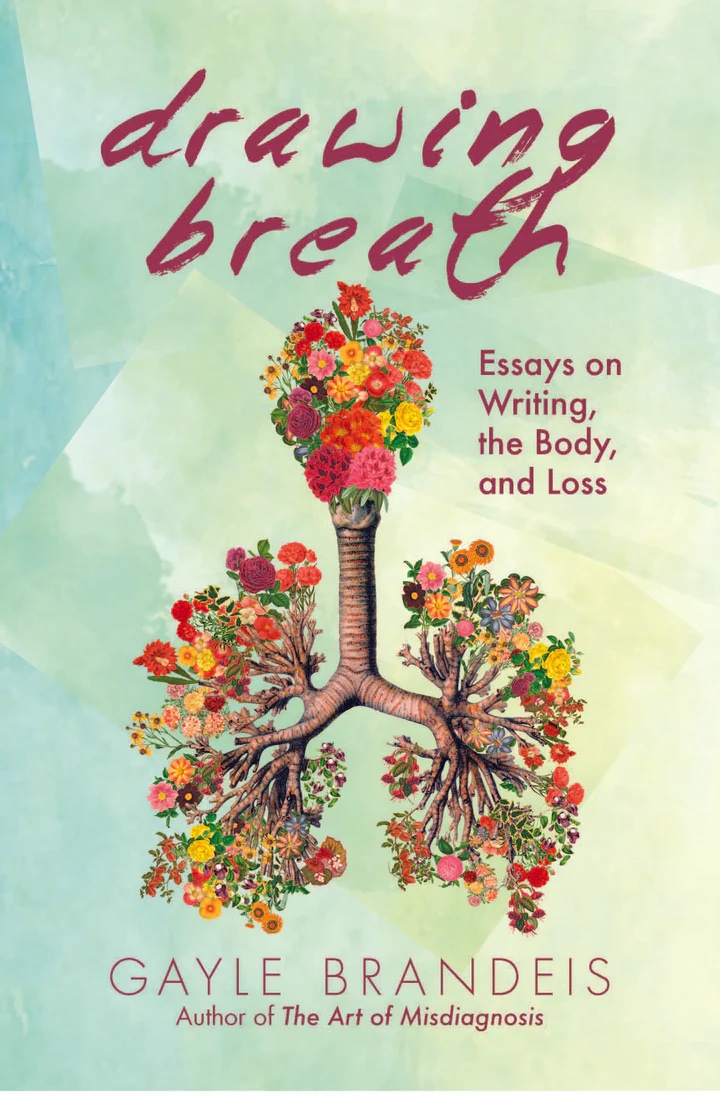
TBR: Drawing Breath: Essays on Writing, the Body, and Loss by Gayle Brandeis

TBR [to be read] is a semi-regular, invitation-only interview series with authors of newly released/forthcoming, interesting books who will tell us about their new work as well as offer tips on writing, stories about the publishing biz, and from time to time, a recipe.


Give us your elevator pitch: whats your book about in 2-3 sentences?


The subtitle of Drawing Breath gives a clear window into what the book holds—Essays on Writing, the Body, and Loss. What it doesn’t tell you, however, is that these essays were written over the span of 20+ years, making this collection a retrospective of sorts, a record of the subjects I keep returning to over time, the steady pulses of curiosity/obsession/devotion within my writing life.


Which essay did you most enjoy writing? Why? And which essay gave you the most trouble, and why?


My 1999 essay, “Spelling” was so much fun to write and makes me so happy every time I read it. It’s about my daughter teaching herself to write as a little girl, and is one of the oldest essays in the book (and I’m realizing I should write about joy more often if I have to look so far back to find my most enjoyable piece! I’ve certainly had fun writing other things since, but this one just felt like pure celebration.) My daughter is in her late 20s now, and is a beautiful writer—I love how that same magic she had as a child continues to sparkle through her. The hardest essay to write in the collection was “Get Me Away From Here, I’m Dying” from 2012 [see link below]. It was the first thing I had written that looked directly at my mom’s suicide, and the process of getting it onto the page was excruciating. The experience of publishing it was terrifying, too, at least at first, but the warm response the piece received gave me courage to keep going to those hard places in my work.


Tell us a bit about the highs and lows of your books road to publication.


Since I didn’t have a book in mind as I wrote the essays within it—I just wrote them as they came to me, and later pulled them together—the presence of the book feels like a lovely surprise, an icing-on-the-cake book. I feel like I have less ego-attachment to Drawing Breath than I do with books I’ve wrestled with single-mindedly for years (even though perhaps there’s more of me in this book than any other, since it does cover such a broad span of time). When Drawing Breath was on submission, I found rejections stung less than they usually do, and I feel like I can let this book journey into the world without burdening it with expectation, maybe because most of these essays have already been published, so I’ve survived the anxiety of those being read publicly, and have received sweet support for them as individual pieces. This is not to say I don’t feel any anxiety about the book release—of course I do!—but it’s a less consuming anxiety than usual. A big high of this process has been landing at Overcup Press—they’ve been a dream to work with (and I have Liz Prato to thank for this…she had taken over the Overcup Twitter feed—they had published her wonderful essay collection, Volcanoes, Palm Trees, and Privilege: Essays on Hawai’i—and when I saw what they were actively looking for, I realized Drawing Breath could be a good fit. I’m grateful they agreed!)


Whats your favorite piece of writing advice?


I return to Hélène Cixous’ advice all the time: Censor the body and you censor breath and speech at the same time. Write yourself. Your body must be heard.” I used the last two lines of this as an epigraph for my 2002 craft book Fruitflesh: Seeds of Inspiration for Women Who Write, and I use another Cixous quote for the epigraph of Drawing Breath. “My body experiences, deep down inside, one of its panicky cosmic adventures. I have volcanoes on my lands. But no lava: what wants to flow is breath. And not just any old way. The breath ‘wants’ a form. ‘Write me!’” (That quote isn’t advice, per se, but it resonates with my experience. Clearly, Cixous speaks to me!) I’ve also held Audre Lorde’s sentence “Your silence will not protect you” close to my writerly heart—it’s guided me through some of my most difficult writing.


My favorite writing advice is write until something surprises you.” What surprised you in the writing of this book?


I love this advice—surprise is one of my very favorite parts of the writing process. As I noted earlier, the fact that my essays coalesced into a book feels like a cool surprise in itself. In terms of surprise during the writing process, I’m going to harken back to “Get Me Away From Here, I’m Dying,” the essay I found the hardest to write. The essay has two parts—the first part is about leaving my first marriage, and the second part is about my mom’s suicide, and I thought the two parts were tied together only by the Belle & Sebastian song I use as the title for this essay, since that song played an important role during both time periods of my life. Then the last sentence of the essay poured out of my fingers and tied the two parts together in a way that surprised the hell out of me and brought me to tears, and I realized “Oh, wow, this is what this essay is about.” My writing is way smarter than I am.


How do you approach revision?


Revision was a wild process with this collection. I often tell my students to set work aside for a while so you can see it freshly (because that works!), but I usually don’t set work aside for 20 whole years and returning to the older work was quite a trip. I noticed some writerly tics in those older pieces that I needed to smooth out (an over-reliance on the word, “though”, for example), and had to do quite a bit of tightening (including removing the then-standard extra space after each period, which now looks like a big gaping hole to me), but I was glad to see they mostly held up over time. Another revision challenge: I’ll often return to the same stories over the course of several essays, because I still have questions about the experience, or want to approach the story from a new angle, or just can’t shake it from my system, and I had to figure out how to remove repetition of information from one piece to the next so the book wouldn’t become a hall of mirrors.


Inquiring foodies and hungry book clubs want to know: Any food/s associated with your book? (Any recipes I might share?)


I adore reading and writing about food, but when I first pondered this question—such a great question!—I couldn’t think of a single dish in the book. Then I combed through the collection and found at least 40 food references (including two discomfiting food “tangles”— “The tangle of shrimp, glistening with butter, looked obscene, like an orgy in the shallow bowl” and “a plate of what they called chow mein looked like a gray tangle of slime.”) I’m not sure how I had forgotten there was so much food in the book, especially since one of the essays is titled “Eating the Food of the Dead” and is about the food my parents and my husband’s mother left behind after they died. Most of the food in Drawing Breath has more emotional resonance than it does any culinary sophistication, but I would be tickled if someone wanted to make my dad’s favorite sandwich: Swiss cheese, mayonnaise, and bread and butter pickles on toasted rye. Buzz sandwiches forever!


As far as more complex recipes go, I feel like I should give you one for cookies, since cookies, I was tickled to discover, appear in four different essays in the collection, and two of those feature thumbprint cookies—some made by my former mother in law in one, my dad’s favorite Pepperidge Farm variety in the other. I don’t think I would have noticed there were two different thumbprint cookies in the book if you hadn’t asked this question—thank you for the fun surprise/discovery! It feels apt to share a recipe for this type of cookie because writing is like a thumbprint, isn’t it? So unique to each writer’s own body/voice. I don’t think I’ve ever actually made thumbprint cookies before (other than helping my beloved former mother in law make hers), but I do want to try this recipe, which works with my various dietary restrictions—https://simple-veganista.com/almond-flour-thumbprint-cookies/ . While both varieties of thumbprint cookies in the book are filled with raspberry jam, I’d like to try the recipe writer’s suggestion to use lemon infused olive oil and rosemary in the cookies, plus I’d add pine nuts instead of the recommended almonds, since one of the most memorable batches of cookies I've ever made were pine nut rosemary shortbread ones from a recipe I found in the Los Angeles Times about twenty years ago (appropriate, given the vintage of some of the essays in this collection). I can still smell and taste that shortbread so vividly two decades later, and am excited to attempt this variation of them soon. I’ll probably fill the thumbprints with a dairy free lemon curd, like the one at https://minimalistbaker.com/vegan-lemon-curd/.


As apt as these cookies are, I’m realizing now that perhaps the most fitting reference to food in the collection is the potluck dinner in my essay “Ghosts in the Ecotone.” That essay takes place during a weekend writing retreat, where all of us had brought dishes to share at a communal dinner, and the table was heaped with all kinds of deliciousness. Drawing Breath is a smorgasbord of sorts, itself—a smorgasbord of my writing, and also a smorgasbord of voices other than my own, since I quote a large number of other writers throughout Drawing Breath. I wanted to set a generous table with this book, and hope readers leave feeling well-fed.


*****


READ MORE ABOUT THIS AUTHOR: www.gaylebrandeis.com


ORDER THIS BOOK FOR YOUR OWN TBR STACK: https://bookshop.org/p/books/drawing-breath-essays-on-writing-the-body-and-grief-gayle-brandeis/18582442?ean=9798985652710


READ AN ESSAY, “Get Me Away from Here, I’m Dying”: https://therumpus.net/2012/05/23/get-me-away-from-here-im-dying/


Wednesday, February 1, 2023

TBR: Big Man and the Little Men: A Graphic Novel by Clifford Thompson

TBR [to be read] is a semi-regular, invitation-only interview series with authors of newly released/forthcoming, interesting books who will tell us about their new work as well as offer tips on writing, stories about the publishing biz, and from time to time, a recipe


Give us your elevator pitch: what’s your book about in 2-3 sentences
?


April Wells, an African American writer, is embedded with the campaign of the presumed Democratic presidential nominee when she is approached by a woman who claims that the candidate once assaulted her. If April doesn’t report on this, she will fail in her duty, but if she does, she will help the racist, misogynist Republican nominee. April’s difficulties only begin there.


Which character did you most enjoy creating? Why?


I most enjoyed creating April, because she is the way I imagine my ideal reader to be and also has aspects of myself. She is intelligent and decent, and she is sometimes sad for reasons she doesn’t fully understand. She has a touch of impostor syndrome. She discovers that the world is even more screwed up than she thought it was, and she tries to call it out, even if she can’t do much more.


Tell us a bit about the highs and lows of your book’s road to publication.


The high—and it was constant—was just the opportunity to tell a story visually, to sit at my drafting table with old blues on the stereo and spend time drawing the characters I came to love. There were some production issues that would be as boring to hear about as there were frustrating to experience, but those frustrations were learning experiences, and they were far outweighed by the good moments.


What’s your favorite piece of writing advice?


It was spoken by the writer Susan Cheever when we co-taught a writing workshop: “Every ant has to carry a crumb.” In other words, if something is in your essay, story, or poem, it has to perform a job—or be taken out.


What surprised you in the writing of this book?


Probably the biggest surprise of all is that I got to do it. My first ambition in life was to be a comic book artist and writer; later I turned to prose writing, but the visual-art impulse never left me. About fifteen years ago I started painting, and I joined Blue Mountain Gallery, a New York City–based artists’ collective, in 2020. (My first solo show opens there in late February.) In about 2019 I had the idea to create a graphic novel, and my publisher, Other Press, was on board. So on the cusp of sixty, I have fulfilled the ambition I had when was a teenager. Not everyone gets to say that, and I feel extraordinarily lucky.


How did you find the title of your book?


Over twenty years ago, I had the idea to call something “Big Man and the Little Men.” It was a title in search of a book—but I was taken with the idea of a charismatic man surrounded by a group of lower-key friends. And there is such a group in my graphic novel: Sam Benjamin is April’s friend from high school and is now the mayor of their hometown. When things get dicey for April, she turns to them for advice.


*****


READ MORE ABOUT THIS AUTHOR: www.cliffordthompson.info


ORDER THIS BOOK FOR YOUR OWN TBR STACK: www.otherpress.com


Monday, January 23, 2023

TBR: I Want To Tell You by Jesse Lee Kercheval

 TBR [to be read] is a semi-regular, invitation-only interview series with authors of newly released/forthcoming, interesting books who will tell us about their new work as well as offer tips on writing, stories about the publishing biz, and from time to time, a recipe.


We don’t expect an elevator pitch from a poet, but can you tell us about your work in 2-3 sentences?


I write poems that grab you in that elevator and urgently tell you about love, death, and the illusive, ever-shifting meaning of life—while also making you laugh. At least once in a while.


2 sentences—though I admit that first one is long. I notice my publisher’s website chose the more economical “Poems That Urgently Remind Us Love Keeps Us Alive.”


What boundaries did you break in the writing of this book? Where does that sort of courage come from?


Though most of the poems in I Want To Tell You were written before the pandemic, I started putting the book together when I was in lockdown in Montevideo, Uruguay. That made me want a book with an urgent, direct, at times even manic, voice. One that speaks directly to the reader. There are no poems about Covid—but there is an “end times” intensity, I think, I hope, about the book. That decision not to hold back, not to “play nice” was the breakthrough for me. I got that courage, if that’s the right word, from my sense in that any moment that I might die, that my reader might die, and there was no time to lose. And though we all feel less panicked now that is the universal human situation in this world.


Which poem did you most enjoy writing? Why? And, which poem gave you the most trouble, and why?


The poem I most enjoyed writing was the title poem, “I Want To Tell You.” It’s the one where I found the direct voice I was looking for:

“I am talking about poetry. / I am talking about breaking out of the neat little box of humorous lines / rising to a     zing / of cosmic meaning at the end.”


I felt it put the reader on notice about what kind of book they were about to read.


The poem that was the hardest was “Ill Call This Death Chartreuse, Her Favorite Color” which is about my sister-in-law who I loved fiercely dying of lung cancer.


Tell us a bit about the highs and lows of your book’s road to publication.


Every book I’ve published has had its own windy path to publication. This one was less complicated than many. I sent the manuscript to Ed Ochester, the long-time editor of the Pitt Poetry Series at the University of Pittsburgh Press. Ed had accepted three previous books from me: my poetry collection Dog Angel and two of my translations of Uruguayan poets, The Invisible Bridge by Circe Maia and Love Poems by Idea Vilariño. And I love being published by Pitt.


Then I heard he was retiring and the press was searching for a new series editor. I assumed the press would not be accepting new books during the transition and so put all thought of my manuscript out of my mind.  I was completely surprised when I got an email saying that I Want To Tell You had been accepted by the new interim editor, Terrance Hayes, and editorial team, Nancy Krygowski and Jeffrey McDaniel. I was in a big Zoom meeting when email arrived and everyone got to see me jumping around and waving my hands like a crazy person (luckily my mic was muted).


What’s your favorite piece of writing advice?


My former students are always quoting back to me things I told them, advice I often do not remember giving. The advice I give myself most often is as much life advice as writing advice: The work is the reward. It’s to remind myself that the writing is what gives me pleasure. Not publication. To be honest, publication, especially of a book, is a bit stressful or, to be even more honest, painful. I always try to be writing away, doing new work when a book comes out.


My favorite writing advice is “write until something surprises you.” What surprised you in the writing of this book?


The surprise was how the book came together. I pulled together older poems I loved that had not been in a book, then wrote new work that addressed the same central issues and it just clicked. That had never happened before. My books are either poetic snapshots in time, like my first book, World as Dictionary, which I wrote right after my daughter was born and while a dear friend was dying of a brain tumor. Or are “project” books like Cinema Muto, which is poems about silent film and the silent film conference I go to every year in Italy,  I Want To Tell You was built around voice, around the person(a) in the poems speaking to the reader and I was genuinely surprised how well that worked as the spine of a book.


What was your experience ordering these poems?


I always struggle with that. Often there is a narrative arc in my poetry books that probably has its roots in my other life as a fiction writer. I have a friend, the poet (Amy) Quan Barry who tells her MFA students to just put their poems in book in alphabetical order by title. So I took that advice—but just as a clean start. Then I starting moving poems, thinking, Oh this one has to come after that one. As I did, I realized the structure was more like a personal essay. I was making an emotional and philosophical argument. I think one of the last things I decided to do was put the title poem, “I Want To Tell You” first, rather than last where I would usually place a title poem. The last poem now, “I am telling you” is more consoling. It ends, “Be the tree./ Be the book./ Be the one who loves & is forgiven. / Be.”


Inquiring foodies and hungry book clubs want to know: Any food/s associated with your book? (Any recipes I might share?)


There are avocados in “I’ll Call This Death Chartreuse, Your Favorite Color” falling from the tree in my sister-in-law’s yard in Miami. These are the big Florida avocados, not the smaller Haas ones. They have a brighter, greener taste. I grew up on them and prefer their taste which is a bit lighter, less oily. And—plus—they are so big a single avocado makes a big bowl of guacamole.


My sister-in-law always used this classic Southern guac recipe which, honestly, is delicious: https://www.readyseteat.com/recipes-RoTel-Rockin-Guacamole-6823


*****


READ MORE ABOUT THIS AUTHOR: www.jlkercheval.com


READ MORE ABOUT THIS PUBLISHER: www.upittpress.org


BUY THIS BOOK FOR YOUR OWN TBR STACK:

You can order the book directly from the University of Pittsburgh Press through the link below but if you click on BUY on their site, it also gives you the option of ordering it from Amazon, Barnes & Noble, Indie Bound, Powells, etc.

https://upittpress.org/books/9780822967071/


Tuesday, January 17, 2023

TBR: Like Water in the Palm of My Hand by Lois Roma-Deeley

TBR [to be read] is a semi-regular, invitation-only interview series with authors of newly released/forthcoming, interesting books who will tell us about their new work as well as offer tips on writing, stories about the publishing biz, and from time to time, a recipe.


We don’t expect an elevator pitch from a poet, but can you tell us about your work in 2-3 sentences?


“Roma-Deeley’s poems seek to pitch imagination beyond itself to something more like divination. These are poems that show us ‘how hard it is to be a human being,’ but which also ‘celebrate the moment of possibility.’”Daniel Tobin


Which poem/s did you most enjoy writing? Why? And, which poem/s gave you the most trouble, and why?


Some of the most enjoyable poems came out of collaborations with visual artists which lead me to surprising and completely unexpected places in my work.  More specifically:


The poems “Be There No End to the End of this Night” (originally published as “Be There No End to the End of this Day”), “Now That,” “Empty Spaces,” “How to Be Rooted,” “If When,” “The Love Poem (I Can Not Write),” and “If I Were Smarter, I’d Be More Afraid” (reprinted) were part of the exhibition Geology of Spirit: A Photo-Poetic Collaboration, with fine art photographers Patrick O'Brien and Cyd Peroni, and with poet Rosemarie Dombrowski. The poems “I Came Here for Some Answers” and “The Virgin River Speaks of Loneliness” were written in response to the work of visual artist Beth Shadur. The poems “What It Is or How to Get There” and “Why Moon Jellyfish Won’t Speak of Cancer” were written in response to the work of visual artist Cherie Buck-Hutchison.

https://www.geologyofspirit.com/

www.bethshadur.com/the-poetic-dialogue-project


 The more difficult poems to write were troubling emotionally. These came out of deeply painful personal experiences. Even though some of those poems garnered national attention, they were difficult to write and difficult to see published.   Several poems in the book came out of my own private experiences with breast cancer.  For example, the New Millennium Writings XLV contest, selected my poem “Why Moon Jellyfish Won’t Speak of Cancer” as a finalist. Such poems dealing with cancer were also include in Vice-Versa’s Illness as a Form of Existence Anthology, which republished “Why Moon Jellyfish Won’t Speak of Cancer” and also included “Absence in Five Parts.”  Similarly, the poem “In My Brother’s Recovery Room” was based on my experience with my older brother’s two week stay in the hospital due to his heart operation. This poem found a home in Italian Americana.


Tell us a bit about the highs and lows of your book’s road to publication.


Almost every poem in this collection has been published. The collection, as a whole, has been a finalist and semi-finalist for national contests. I was pleased to know the poems and the collection as a whole resonated with various and varied audiences but it always stings to come close and “still no cigar.” However, I eventually was elated to find Kelsay Books as my new publisher and am so pleased with my experience with them.


What’s your favorite piece of writing advice?


My favorite pieces of writing advice are “write line by line,” “write until something surprises you” and “allow everything that wants to come into the poem, come into it.”   All these pieces of advice have one thing in common—they allow for a “give and take” between craft and imagination. For me, the best poems come when I am not clutching onto perfectionism—when I write a line and then allow my imagination to expand.  There is a kind of joy I experience when I write another line and see where that line will take me. At this point, I will remember that craft will help me shape the poem into its ultimate form. In other words, it is more than okay to be messy.


What surprised you in the writing of this book?


Many voices demanded to be heard in this book. I was surprised by how those voices connected with me and how they lead me on a journey toward a deeper understanding of “how very hard it is to be a human being.”


How did you find the title of your book?


This collection explores the nature of change and its relationship to time and timelessness which, to my mind, seem to co-exist within each of us. In addition, I am fascinated by the limits and lessons of memory and how memory often serves as a conduit to the past but can also be a bridge to the future.  The present moment is fraught with competing realities which seem to crystalize and then, too soon, disappear, “like water in the palm of my hand.” Are we, as human beings, the sum of our choices? Are we trapped or enlarged by those choices?


Inquiring foodies and hungry book clubs want to know: Any food/s associated with your book? (Any recipes I might share?)


I am Italian-American and love to create a feast for my family and guests. So I would say this book would go perfectly with my Baked Ziti, stuffed mushrooms, Pinot Noir wine, crusty Italian bread served and Caprese Salad. I don’t use a written down recipe for the Baked Ziti. I just make the dish as my mother taught me. However, I’ll include a recipe for Caprese Salad, which is refreshing—as I hope readers will find of the poems in my book: https://www.foodnetwork.com/recipes/rachael-ray/caprese-salad-recipe-1939232


*****


READ MORE ABOUT THE AUTHOR:

https://www.loisroma-deeley.com/


READ MORE ABOUT THIS PUBLISHER:

https://kelsaybooks.com/products/like-water-in-the-palm-of-your-hand


ORDER THIS BOOK FOR YOUR OWN TBR STACK:

https://kelsaybooks.com/collections/all


WATCH A VIDEO POEM, “Now That”:

https://youtu.be/5VOgDsSFb_g


Work-in-Progress

DC-area author Leslie Pietrzyk explores the creative process and all things literary.