Monday, August 19, 2024

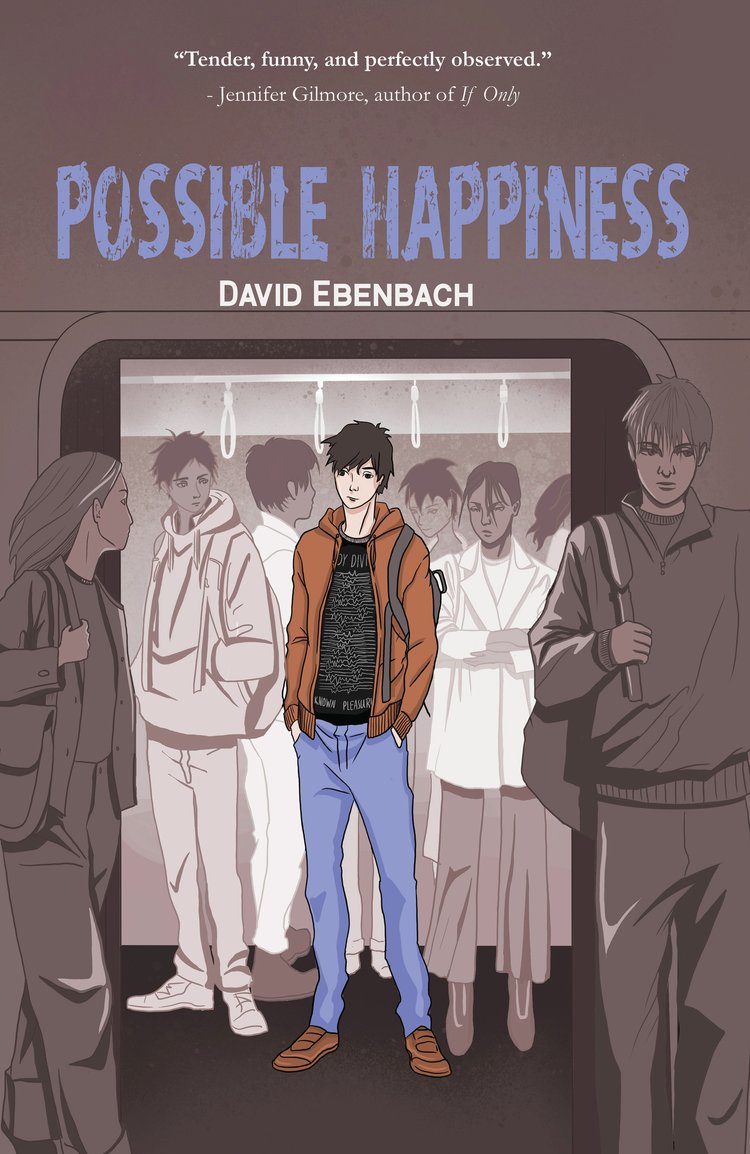
TBR: Possible Happiness by David Ebenbach

TBR [to be read], a semi-regular, invitation-only interview series with authors of newly released/forthcoming, interesting books.


Give us your elevator pitch: what’s your book about in 2-3 sentences?


A loner teen accidentally unlocks a social life with his sense of humor—but can he unlock meaningful happiness that way, too, or will he first have to face and understand himself?


Which character did you most enjoy creating? Why? And which character gave you the most trouble, and why?


The book is told from the point of view of Jacob—that loner teen from the elevator pitch—and I really enjoyed spending time with him. He’s based (very loosely) on a teenaged me (and the book is set back in the late 80s, when I was a teenager), and so it was like hanging out with a version of my younger self, getting to observe all of the hopeful foolishness and chaotic earnestness—but from a semi-safe distance this time around.


His friends were harder to write, because of the particular nuance I was trying to capture: that these characters could be perfectly great people, and yet still struggle to supply whatever it was that Jacob ultimately needed. In that way, folks can be disappointing without actually being at fault.


Tell us a bit about the highs and lows of your book’s road to publication.


Well, the lowest low was when my agent told me that the book wasn’t to his taste and didn’t feel like he was the right person to submit it to presses. Yeah—that was a low point. He said it nicely, though—he’s still my agent—and he told me it was okay if I wanted to take it out to presses myself. He’s not a possessive guy. And so I did take it out myself, and luckily found people who connected with the book more than my agent did.


In particular, Regal House Publishing got excited. So one big high was them sending the contract, and me signing it. After that, there were the usual rounds of editing and proofreading and finalizing a cover and so on, all of which were smooth. And then, finally—I started working on this book back in 2016—Regal House sent me a physical copy of the book. That’s a very high point right there. As Salman Rushdie writes in his excellent new memoir, Knife, “the best moment of the whole process of book publication is this one, the moment when you hold your printed book in your hand for the first time, and you feel its reality, its life.”


What’s your favorite piece of writing advice?


Don’t write what other people want you to write; write what you have to write.


My favorite writing advice is “write until something surprises you.” What surprised you in the writing of this book?


This is such an interesting question, and a hard one for me to answer. In a certain sense, everything surprises me when I write a book—I never know how it’s going to play out before I get to the page. Or at least I never know that I know. Because, in another sense, nothing about the process surprises me. In fact, I typically write not toward surprise but instead toward whatever is most emotionally difficult for me to get into. The hard stuff that’s already there and that maybe I’m somewhat aware of, the way that you’re aware of shadows in the room, but that I haven’t been willing to look at directly. And so, a lot of the time my writing process is more about uncovering than about discovering. Maybe the surprise, each time, is that I’m able to go there—and come back out unharmed.


How did you find the title of your book?


Coming up with Possible Happiness, the title of this book, was a process. Oy. For a long time I called it Fern Rock, after the Philadelphia Broad Street Subway stop—but that made it sound like the novel was happening in some rural paradise instead of in one of the grittiest cities in America. So I lost faith in that option and just called the book “that high school novel” for a long time. It remained “that high school novel” through failed experiments with titles like Where Do the Children Go (based on a song from the time), Subway-Surface (based on public transportation), and We’re Getting There (the actual, I’m-not-making-it-up slogan of SEPTA, Philly’s public transportation organization, for many years). None of it really suited this particular high school novel.


And then I thought about the scene where protagonist Jacob goes into a kind of occult shop on South Street where all of the purported potions have anti-lawsuit hedges in their names like “so-called” or “alleged,” and he sees something called Possible Happiness Syrup. I thought: that’s what my guy needs. He needs a possible happiness. He needs to stop fighting for some generic kind of happiness that works for everyone else or some magical kind of happiness that only works in the movies. He needs to turn his effort toward getting a real happiness, one that’s possible for him.


Inquiring foodies and hungry book clubs want to know: Any food/s associated with your book?


Well, the main character is a teenager, and not so great in the kitchen, so he’s not the kind of person who produces recipes. When he’s home alone, his single mother working yet another double-shift, he just heats up some frozen mac’n’cheese. So maybe that could make for a good book club treat? Though, if you want to be true to the time period (late 80s), you’ll have to find the Stouffer’s frozen mac that comes in a foil tray, and you’ll have to heat it up in a conventional oven. It takes a while, but it’s worth it.


*****


READ MORE ABOUT THIS AUTHOR: https://www.davidebenbach.com/


ORDER THIS BOOK FOR YOUR OWN TBR STACK: https://regal-house-publishing.mybigcommerce.com/possible-happiness/


Monday, August 12, 2024

TBR: A Season of Perfect Happiness by Maribeth Fischer

TBR [to be read], a semi-regular, invitation-only interview series with authors of newly released/forthcoming, interesting books.


Give us your elevator pitch: what’s your book about in 2-3 sentences?


Ten years before A Season of Perfect Happiness begins, Claire had a life she loved:  She lived in a beautiful beach town, was close to her family, had great friends, and was married to her high school sweetheart. When a tragedy upends it all, she understands that her only chance to have “a normal life” is to start over in a new town. Now, after nearly a decade in Genesee Depot, Wisconsin, she’s finally ready to find love, even happiness. But what of her past does she owe her new friends or the man with whom she falls in love? This is the question at the heart of the novel: What is our most authentic self? The one we try to hide or the one we strive each day to be?  


Which character did you most enjoy creating? Why? And which character gave you the most trouble, and why?


I loved writing Annabelle, the ex-wife of the man Claire falls in love with, and Claire’s closest friend.  Right there, you have a complicated, tangled relationship. In an early draft, a reader told me she didn’t find it believable that an ex would get so friendly with the new woman. But I’d grown up in a family where my dad and stepfather became close friends, and I knew it was possible. I loved the challenge of making Annabelle and Claire’s friendship believable. Annabelle was fun too because she herself is fun, and funny, smart and generous. But she is also damaged and insecure and so ends up causing enormous damage to the people she loves. So far readers have loved and hated her all at once, which thrills me!


The most difficult character was Claire’s former best friend, Kelly, who didn’t want Claire in her life after the tragedy (which was connected to Kelly). I didn’t always understand why Kelly would be so unforgiving and I had to work hard to figure her out…


Tell us a bit about the highs and lows of your book’s road to publication.


The highs

·       Getting the first email from my editor at Dutton, which began, “welcome home.” Dutton had published my first book 20 years earlier. It felt like a homecoming.

·       Seeing the cover for the first time,

·       My dad, who was the first one to read the galley, calling in tears to tell me he’d finished it in two days—and couldn’t stop thinking about it.

·       A similar call from my older brother and my mom

·       Seven months before the release date, having the event coordinator at my local library (Lewes Public Library) and the owner of my local independent bookstore (Browseabout Books) telling my publicist that they wanted to host a launch party for me. Arrangements were made and the event was ready for RSVP’s in a less than an hour. I felt so lucky and grateful to live in the community I do.


The lows


·       Redoing a major piece of the plot—and having to do it in ten days. So, basically rewriting the novel in little more than a week. I didn’t, sleep, eat, bathe! But also in this, my husband, when I said, “I can’t do this. It’s not possible,” looked at me and responded, “What do you mean? This is what you do, Maribeth. This is who you are. Of course you can do it.” His saying that, his unequivocable belief in me? That’s another high.  


What’s your favorite piece of writing advice?


Write big and messy; write way more than you’ll ever need and then edit. Along with this is my favorite quote, by Elie Wisel. “There is a difference between a book of two hundred pages from the very beginning, and a book of two hundred pages, which is the result of an original eight hundred pages. The six hundred pages are there. Only you don't see them.”  


My favorite writing advice is “write until something surprises you.” What surprised you in the writing of this book?


Near the end of A Season of Perfect Happiness a minor character suddenly sort of stepped out of the pages and came alive in a way that allowed me to see a whole other aspect of him. I didn’t need him to do this 40 pages from the end of the book, but the novel is so much better because he did.  


How do you approach revision?


I love revision. It’s part of my “write big and messy.” I meet with poet and novelist, Anne Colwell every week to review our writing (and we’ve been doing this for twenty years) and every place she says, “I could stay here awhile,” meaning, “I want more,” I dive in and see how far I can take the scene she’s questioning or the backstory or the thoughts she wants my character to consider. I write into the story as long and as deeply as I can. I have never not discovered something important that I needed to know in doing this.


Inquiring foodies and hungry book clubs want to know: Any food/s associated with your book? (Any recipes I might share?)


Alas, no…but the book mostly takes place in Wisconsin, so there’s always bratwurst…


****

MORE INFORMATION ABOUT THIS AUTHOR: https://www.maribethfischer.com/


ORDER A COPY OF THIS BOOK FOR YOUR OWN TBR STACK: https://browseaboutbooks.com/book/9780593474679


Monday, July 8, 2024

TBR: Our Kind of Game by Johanna Copeland

TBR [to be read], a semi-regular, invitation-only interview series with authors of newly released/forthcoming, interesting books.


Give us your elevator pitch: what’s your book about in 2-3 sentences?


I first described the book as, “It’s about women who do bad things to violent men,” which always got an “Oooh!” My team at Harpers softened it to “A book that asks what it means for a woman to be in control of her own life.”


Which character did you most enjoy creating? Why? And which character gave you the most trouble, and why?


Paula, Paula, Paula! She was, by far, the most difficult character to write because her voice is so particular. With limited formal education and an undiagnosed learning disorder, her voice is less educated, but I needed readers to trust and respect her intelligence. It was a difficult balance, but with each subsequent draft she became my favorite character because Paula functions as the moral center of the book.


Tell us a bit about the highs and lows of your book’s road to publication.


The road to publishing this book has been ridiculously fun. Like the Anne Hathaway movie about a woman who gets a book published. In brief, this book was pre-empted by my favorite editor of the group who made offers. Since that time, my team has been amazing. However, this experience comes after starring in no less than three horror movies filmed over the previous decade, where a woman questions her life choices after going out on endless rounds of fruitless submission.


What’s your favorite piece of writing advice?


Persevere, but be kind to yourself. I’m good at the first part of that advice and terrible at the second part. I always forget that writing is actually hard work. As though plot, setting and dialogue should just flow, right?!? When they don’t, I assume the problem is me. This is when I have to take a step back and remind myself that writing is actually a difficult job and I shouldn’t be so mean to the writer.


My favorite writing advice is “write until something surprises you.” What surprised you in the writing of this book?


So many of the twists in this book revealed themselves as I was writing it. That’s something that always happens, but still catches me by surprise. I wish I wrote from an outline so I could avoid the stress of not knowing how outstanding threads will weave into the plot, but I’m just not that person. In this book, there’s a twist/reveal in the last chapter that didn’t come until the fourth revision. It was hanging out there unresolved, then suddenly it clicked. For me, those moments are the most surprising and satisfying parts of novel writing.


Who is your ideal reader?


Our Kind of Game is marketed as a domestic thriller or women’s fiction, which makes it a little weird that my ideal reader is men in heterosexual relationships. While it’s a cathartic read for women, the men who’ve read it tell me it challenged their perceptions around the way they think about their partner’s domestic labor. I can’t imagine a better outcome for a reader than a book that challenges preconceived notions and entertains.


Inquiring foodies and hungry book clubs want to know: Any food/s associated with your book?


Ahahaha, I have a great recipe for canned cherries! I can’t say anything else without it being a spoiler, but after people read this book, they’ll understand why that question made me laugh out loud.


*****


READ MORE ABOUT THIS BOOK: https://www.harpercollins.com/products/our-kind-of-game-johanna-copeland?variant=41141589966882


ORDER THIS BOOK FOR YOUR TBR STACK: https://bookshop.org/p/books/our-kind-of-game-johanna-copeland/21024793


Monday, June 17, 2024

TBR: We Alive, Beloved by Frederick Joseph

TBR [to be read], a semi-regular, invitation-only interview series with authors of newly released/forthcoming, interesting books. 


We don’t expect an elevator pitch from a poet, but can you tell us about your work in 2-3 sentences?


I consider myself a storyteller above all else, weaving tales of resilience and hope from the heart of Yonkers to the shelves of the world. My words live across genres, from poetry's intimate embrace in “We Alive, Beloved” to the calls for justice and understanding in “Patriarchy Blues” and “The Black Friend.” Each sentence I write is meant to help us all become a bit freer, whether that’s in the body, mind, or soul.


Which poem/s did you most enjoy writing? Why? And, which poem/s gave you the most trouble, and why?


I most enjoyed writing many of the poems in “We Alive, Beloved” because each one allowed me to explore different facets of the Black experience and celebrate resilience, joy, and love. However, the poem that gave me the most trouble was “The Odyssey.” This poem is very personal, reflecting on a Black life from birth onward. It attempts to be speculative while also playing on some of the prose found in Homer's “Odyssey” and other epic poems. Balancing these elements and doing justice to such a profound subject made it a challenging piece to write.


Tell us a bit about the highs and lows of your book’s road to publication.


The journey of bringing “We Alive, Beloved” to life has been filled with highs and lows. One of the lows is that, as I write this, the collection is delayed a week due to printing logistics. Additionally, getting more people to engage with poetry, especially those who are more familiar with my essays and fiction, has been a mountain to climb. Still, the joy of seeing my poetic expressions take shape and the anticipation of sharing these deeply personal pieces with the world.


What’s your favorite piece of writing advice?


As a writer, the advice I can offer is to embrace the power of your authentic voice. Write from the depths of your soul, unfiltered and unapologetic. Authenticity resonates; it has the power to move mountains and touch hearts. Don’t shy away from the raw, the real, and the vulnerable. Let your words reflect the truth of your experiences, the richness of your heritage, and the unique perspective only you can bring.


My favorite writing advice is “write until something surprises you.” What surprised you in the writing of this book?


What surprised me, deeply and profoundly, was how much certain moments from my past still sit with me. Writing this book unearthed memories long buried, reminding me that our past is never truly behind us; it sits in the marrow of who we are and what we create.


What’s something about your book that you want readers to know?


I want readers to know that I cried after finishing most of the poems in the collection. Each verse is a reflection of our shared struggles, our triumphs, and the silent battles fought in the depths of our souls. Those tears weren’t just mine; they belong to the history, the present, and the future of a people who continue to rise.


Inquiring foodies and hungry book clubs want to know: Any food/s associated with your book?


I love that question! This book is so tied to my grandmother that I would have to say the book reads best with a slice of sweet potato pie. Which was her specialty.


*****


READ MORE ABOUT THIS AUTHOR: www.frederickjoseph.com


ORDER THIS BOOK FOR YOUR TBR STACK:  https://www.simonandschuster.com/books/We-Alive-Beloved/Frederick-Joseph/9781955905640


Monday, May 20, 2024

TBR: The Body Is A Temporary Gathering Place by Andrew Bertaina

TBR [to be read], a semi-regular, invitation-only interview series with authors of newly released/forthcoming, interesting books. 


Give us your elevator pitch: what’s your book about in 2-3 sentences?


It’s a bit of a roundabout memoir in essays. The essays take place over about eight years of my life when I went through a lot of upheaval. Elevator pitch, it’s a mid-life crisis novel about parenting, divorce, identity and faith or lack thereof.


Which essay did you most enjoy writing? Why? And which essay gave you the most trouble, and why?


I had the most fun writing my essay “On Trains.” [See below for link.]  I think it was the first essay where I hit on the idea of just riffing on a subject matter. Thus, it’s about wedding trains, how Einstein used trains to prove his special theory of relativity, a guide to trying to make love on a train etc, all mixed with intersections with trains from my own life. It felt very freeing. At the same time, it was a kind of challenge to scour my memories for train related content. 


As for the hardest, I’d probably say the essay “On Baths.” I was closing in on the nadir of my mid-life crisis, deeply floundering, and I think that essay deals directly with the beginning of that fallout. I honestly don’t like to say any essay is too hard to write. It feels disingenuous when I’ve written the damn thing. Technically then, I’d say the essay “A Field of White,” because I had to find an internal structure to make it work. Otherwise, it was just too scattered. I like digressions; they mirror thought. However, internal structure is still useful, and I borrowed my structural device from John McPhee’s essay, “The Search for Marvin Gardens.”  In my essay, the mooring point is a tea party I’m having with my three-year-old and her stuffed bear.


Tell us a bit about the highs and lows of your book’s road to publication.


Risking honesty, I wound up as notable in Best American Essays three out of the last four years. I know notable isn’t in the book, but I thought it might mean people would be clamoring for a collection. As always, my inbox was empty, so I had to figure out how I wanted to proceed.


My editor at Autofocus, Michael Wheaton, is an absolute gem, and he worked with me on finding a cohesive collection of essays. He was generous with his time and editing, and I’m deeply thankful to have worked with him. It ended up all right, but, as always in writing, I discovered the appetite for reading just isn’t that wide. But I have a beautiful book and a great set of essays that I’m proud of. They hold up.


What’s your favorite piece of writing advice?


I don’t own a single craft book volitionally. However, I think consistent writing is useful. Once you have a basic set of skills, it’s getting your butt in the chair. I often don’t, but I tend to feel better when I do. I tell my students who are struggling with it to just set a timer and do thirty minutes a day. That’s it. You can up it to four hours or whatever, but you should start small and build up. My paraphrase is, editing is writing, but you can’t edit nothing.


My favorite writing advice is “write until something surprises you.” What surprised you in the writing of this book?


I think I was surprised, mostly on a reread, with how much I was mentally suffering during the writing of these essays. In a way, it’s almost painful to go back and see so much wild energy and confusion without much purpose. I think it certainly captures something, and it’s not as though I have things figured it out now, but I was surprised at the kind of desperation I was giving off during those years, this mad desire to figure out life.


How did you find the title of your book?


The title of my book came to me in a dream. Okay. That’s a lie. But I like that lie. The title just seemed right. I meditate a bit. I don’t think the self is particularly real, and I think it’s even less solid for some of us, myself included. I have a hard time projecting myself into the future or feeling connected to my past. I have an essay that talks about it. Also, I think about death a bit. That life is temporary can be terrifying or beautiful. Choose wisely.


Inquiring foodies and hungry book clubs want to know: Any food/s associated with your book? (Any recipes I might share?)


I have an essay called “Eating Animals” in the book, but it includes several things that no reader would actually want to cook, including one’s spouse.


*****


READ MORE ABOUT THIS AUTHOR: https://andrewbertaina.com/


ORDER THIS BOOK FOR YOUR OWN TBR STACK:  https://www.autofocuslit.com/store/p/the-body-is-a?fbclid=IwAR0xmIb08R6M7sXuZAAeNVv8P9rOpO5nR4sLpVtUpSZcyUy3v2QyF_KiZQ0_aem_Afb-FrxmnqNxojEQPW9ZOlCiA2xorxK8ktsNmdS3FV4yg7FMRBCbueRuRTeTxq-6oCTAJHaNvutOLKDJk0TjjZYr


LINK TO AN ESSAY FROM THIS BOOK, “On Trains”:  https://greenmountainsreview.com/on-trains/


Monday, May 13, 2024

TBR: Rebel Falls by Tim Wendel

TBR [to be read], a semi-regular, invitation-only interview series with authors of newly released/forthcoming, interesting books. 


Give us your elevator pitch: what’s your book about in 2-3 sentences?

 In 1864, during the last months of the Civil War, a troubled, young woman is sent to the border with Canada. Rory Chase’s assignment? To stop Confederate spies from seizing the lone Union warship left on the Great Lakes. (Much of this novel is based upon true events.)


Which character did you most enjoy creating? Why? And which character gave you the most trouble, and why?


Rory Chase enthralled and confounded me. Early on, she disguised herself and tried to join a Yankee infantry regiment. After her identity was discovered, Rory became a Union spy. By late 1864, Confederate spies had targeted the U.S.S. Michigan and planned to bombard Cleveland, Buffalo and other cities on the eve of the presidential election. To stop them, Rory must find the courage to not only follow orders but know when to break the rule, too.


Also, I enjoyed writing about the rebel spies – John Yates Beall and Bennet Burley They are based on real-life people. Beall crossed paths with John Wilkes Booth, while Burley was a soldier of fortune from Scotland. When the war ended, he got away and became a foreign correspondent for The Daily Telegraph in London.


To stop the rebels, Rory needs the help of the wait staff at the Cataract House hotel, once a key stop on the Underground Railroad. That this sinister plot takes place in the shadow of Niagara Falls, one of the most captivating places in the world, was good fun to write.


Tell us a bit about the highs and lows of your book’s road to publication.


On the road to publication, the novel was “orphaned” twice, meaning that my editors left for positions at other publishing houses. In the end, though, it worked out. Each of the three editors – Dean Smith, Michael McGandy and Mahinder Kingra  – brought distinctive reactions and insightful comments. It was up to me to incorporate their suggestions into the novel.


What’s your favorite piece of writing advice?


Remember that rejection and failure are not the same. To me, rejection is a temporary setback. It may really, really sting, but how you react to it is up to you. In comparison, failure means that you’ve moved on. Turned the page. And that may be what’s needed at the time. Still, the final choice is yours, and there’s something empowering about that. At least to me.


My first novel, CASTRO’S CURVEBALL, was rejected 33 times before it found a home with the Ballantine imprint at Random House. During that process, time and again, I saw ways to improve the story. Even when editors or agents ultimately turned it down, I believed I was making progress and was game to try again.


My favorite writing advice is “write until something surprises you.” What surprised you in the writing of this book?


 By ingratiating herself to the rebel spies, trying to win them over, Rory risked losing her purpose, even herself as well. In the end, Rory was faced with a difficult decision – Join ‘Em, Leave ‘Em, or Take ‘Em Down. I didn’t start with that template, but eventually I realized that some of my favorite stories follow a similar organization, including THE GREAT GATSBY, THE HANDMAID’S TALE and THE OUTSIDERS.


How did you find the title of your book?


Gregg Wilhelm, a longtime friend, and director of the George Mason writing program, suggested it. A play off Niagara Falls. Then I took it a step further. Late in the novel, Beall and Burley, the rebel spies, discuss how the world will be different if they capture the Union warship. How the Confederacy could become a separate nation, with statues to Robert E. Lee and Stonewall Jackson throughout the land, even perhaps erected in the shadow of Niagara Falls.


I wrote much of this book after moving to Charlottesville, Virginia, where era statues and views of our nation’s past can be contentious issues. Walking through town, you’re reminded of the Lost Cause of the Confederacy and how it still casts a long shadow.


Inquiring foodies and hungry book clubs want to know: Any food/s associated with your book?


 The Cataract House hotel was known for its fine food. Served family style in an expansive dining room with crystal chandeliers, the fare included roast beef, baked white fish, salad, roasted potatoes, succotash, along with a dessert trolly wheeled to your table. A new restaurant recently opened on the American side of the Falls based on an 1859 menu from the Cataract House.


Also, the Bourbon Old Fashioned was all the rage during the 1860s. That allowed me to have Rory Chase partake of the cocktail during a pivotal scene.


Bourbon Old Fashioned (Several of my characters love the cocktail. I do, too.)

From Liquor.com (https://www.liquor.com/recipes/bourbon-old-fashioned/)

1 teaspoon sugar

3 dashes Angostura bitters

1 teaspoon water

2 ounces bourbon

Add the sugar and bitters into a mixing glass, then add the water, and stir until the sugar is nearly dissolved. Fill the mixing glass with ice, add the bourbon, and stir until well-chilled. Strain into a rocks glass over one large ice cube.


*****


READ MORE ABOUT THIS AUTHOR: www.timwendel.com


ORDER THIS BOOK FOR YOUR OWN TBR STACK:

https://www.cornellpress.cornell.edu/book/9781501774881/rebel-falls/#bookTabs=1


READ AN EXCERPT FROM THIS BOOK:

https://www.timwendel.com/works.htm


Monday, May 6, 2024

TBR: Splice of Life: A Memoir in 13 Film Genres by Charles Jensen

TBR [to be read], a semi-regular, invitation-only interview series with authors of newly released/forthcoming, interesting books. 


Give us your elevator pitch: what’s your book about in 2-3 sentences?


Movies and memory intertwine in Splice of Life. Each chapter hybridizes traditional memoir storytelling with discussion of a single film whose plot, symbols, or themes resonate with my lived experiences.


What boundaries did you break in the writing of this book? Where does that sort of courage come from?


This is a nontraditional memoir, first because it is episodic and thematic, and second because I braided traditional memoir conventions with film analysis. Movies have always been so important to my life. If I weren’t a writer, I’d be a filmmaker. I wasn’t sure this was a book people would want to read, but the book as “product” is not something I think a lot about until it’s all done. Writing is always an exploration for me. Can I do this? Can I extend it and keep it interesting? Can I surprise myself along the way? I majored in film studies as an undergrad and film theory and form have inspired how I write poetry. For this book, I wondered what would happen if I leaned all the way in that. If I put movies into my book. If, by doing so, I could create a web of connections between them and me, between them and the reader, and between the reader and me.


Tell us a bit about the highs and lows of your book’s road to publication.


This was the fastest I’ve ever published a book. I started writing it in 2018 and dove into the first draft of the last essay in late 2020. I took classes at UCLA Extension with Shawna Kenney and Gordon Grice to help me revise a few chapters. A literary agent who visited Shawna’s class suggested I look to an indie or university press for this, so while I queried agents for a traditional publishing route, I also queried academic presses and submitted to indie presses, mostly through competitions. The queries weren’t successful, but then I got an email from Andrew Gifford at Santa Fe Writers’ Project telling me my manuscript was a finalist for their annual prize and that they wanted to publish it. That was October 2022. I had convinced myself somehow that this book was unpublishable and unreadable, so it was really surprising to me. I’m still trying to get comfortable with the idea people might enjoy reading this—a good reminder that publication doesn’t cure your insecurities! The way my mind works, I just don’t let positivity in for more than a few seconds. The high in the publishing process were those few seconds after I got Andrew’s email, and the lows were almost every other moment, when I was certain the book would never come together.


What’s your favorite piece of writing advice?


It’s not really advice, but it’s Louise Glück’s introduction to her collection The First Four Books of Poems. It’s a brief meditation on the books gathered there, but what she wrote fundamentally changed how I write. She catalogs how, after publishing each collection, she looked back at what she seemed focused on, and what she had avoided. Her first book used a lot of sentence fragments, so in the second she challenged herself to write complete sentences. She noticed she resisted using question marks in another, so pushed herself to let questions occupy poems in the next book. If I could distill it down into actual advice, I’d say something like be sure you know where you’ve been so next time you can set out for somewhere new.


My favorite writing advice is “write until something surprises you.” What surprised you in the writing of this book?


My editor Adam al-Sirgany actually pointed this out to me. There’s a weird mirroring of the chapters in the book, with the seventh chapter serving as a hinge. The first chapter and last chapter concern competitions (prom court and Jeopardy, respectively). The second and twelfth are deeply internal meditations on gender and sexuality. The third and eleventh are about dangerous seductions and how we are broken by them. And so on. I didn’t plan that, but it’s present, and I’m obsessed with it!


How did you find the title of your book?


Titles are really important to me, and they usually make themselves known to me early on. Since I didn’t know I was working on a book until I had several chapters written, though, it wasn’t until I was done that I reached for a title. The idea of the cutting room floor was on my mind from the jump—the idea that in the process of putting together a story, there’s a lot we leave behind—and when I published the earliest essays, I titled them “Spliced: [essay title] / [film title].” That naturally evolved into the book title, which plays on the vignette nature of the chapters—slices of life—but spliced to include these other narratives. The subtitle changed several times and I owe the final version to Shawna’s class, where I realized genre was one of the unifying elements of my lived experience and the films I selected to pair with them.


*****

READ MORE ABOUT THIS AUTHOR: https://charles-jensen.com


ORDER THIS BOOK FOR YOUR OWN TBR STACK: https://www.amazon.com/Splice-Life-Memoir-Film-Genres/dp/1951631331


READ A SELECTION FROM THIS BOOK, “Psychological Thriller”:

https://expositionreview.com/issues/vol-vii-flux/psychological-thriller/


Work-in-Progress

DC-area author Leslie Pietrzyk explores the creative process and all things literary.